










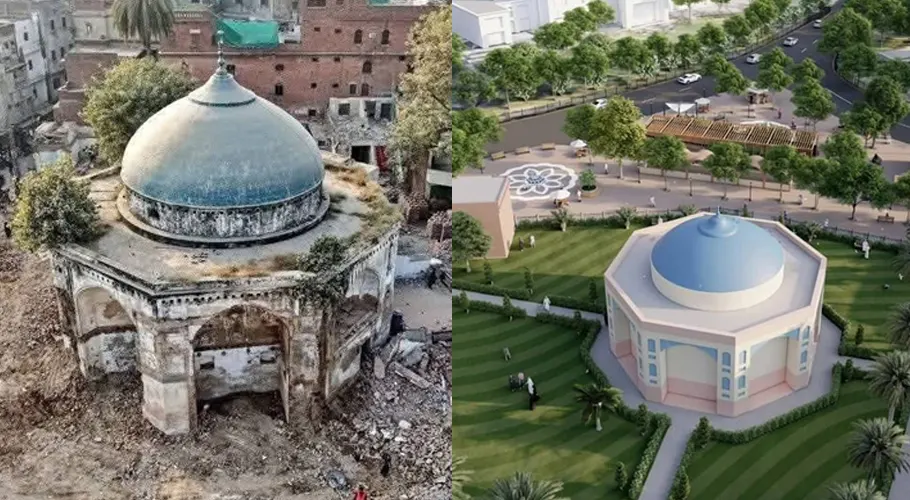
In the heart of Lahore, a historic structure long known to the public simply as “Neela Gumbad” has finally been revealed in its original form.
For centuries, this monument remained hidden, partly buried underground and concealed behind small shops and houses, making it invisible to most people for decades.
Neela Gumbad is, in fact, the mausoleum of Muhammad Saleh Kamboh, a prominent figure during the reigns of Mughal emperors Shah Jahan and Aurangzeb. He was an important official whose contributions, including authoring the renowned ‘Amal-e-Salih’, hold significant historical value. In earlier times, the blue dome of this tomb would glow at dusk and enhance the beauty of the city.
Credit goes to Muhammad Nawaz Sharif 💯 https://t.co/HopVqOK0lU
— Maryam Nawaz Sharif (@MaryamNSharif) November 26, 2025
Over time, Lahore’s growing traffic, illegal constructions, and the expansion of small shops around the area completely obscured the mausoleum. Local shopkeepers and residents used parts of the structure as storage rooms or workspaces, further damaging its original beauty, blue tilework, and architectural elements.
After years of delay, the Punjab government under the leadership of Maryam Nawaz—finally decided that this heritage site could not be allowed to deteriorate further. Illegal shops and encroachments were removed, and the site was cleared. For the first time in decades, citizens can now see the Neela Gumbad open to the sky and appreciate its true magnificence.
Today, Neela Gumbad stands not only as the resting place of Muhammad Saleh Kamboh but also as an important symbol of Lahore’s rich history and cultural identity. Its restoration serves as a reminder that protecting heritage sites is essential, and sometimes, amid the evolution of a city, history manages to reclaim its rightful place.