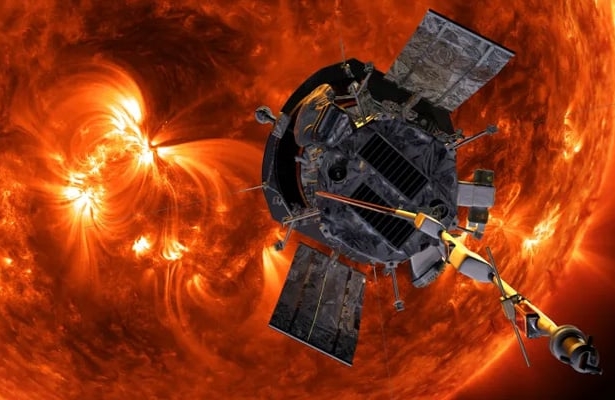
NASA historic spacecraft captured never-before-seen images of the sun from a record-breaking distance of just 3.8 million miles (6.1 million kilometers)—closer than any human-made object has ever ventured before.
The stunning images, taken during a daring flyby on December 24, 2024, are helping scientists unravel one of the sun’s biggest mysteries: how solar wind forms and escapes the sun’s intense gravity.
According to Live Science, these observations provide crucial insights into the corona—the sun’s superheated outer atmosphere—where solar wind originates.
Solar wind is a constant stream of charged particles that flows outward, influencing everything from Earth’s magnetic field to the dazzling Northern and Southern Lights (auroras).
However, it can also trigger powerful geomagnetic storms, disrupting satellites, power grids, and communication systems. Understanding its origins could help us better predict—and prepare for—these space weather events.
One of the biggest puzzles has been the slow solar wind, which moves at lower speeds but is far denser and more unpredictable than the fast solar wind. For decades, scientists have debated how it forms and why it behaves so differently.
Thanks to the Parker Solar Probe’s latest findings, researchers now have a major breakthrough. The data confirms that the slow solar wind isn’t uniform—it actually consists of two distinct types:
Alfvénic wind – Likely emerging from cooler regions of the sun called coronal holes.
Non-Alfvénic wind – Possibly released from hot magnetic loops known as helmet streamers.
“The big unknown has been: how is the solar wind generated, and how does it escape the Sun’s immense gravitational pull?” said Nour Rawafi, the Parker Solar Probe project scientist at Johns Hopkins Applied Physics Laboratory.
“Understanding this continuous flow of particles, particularly the slow solar wind, is a major challenge—but we’re finally getting answers.”
Launched in 2018, the Parker Solar Probe is humanity’s first mission to “touch the sun”—flying directly through the corona.
To withstand temperatures exceeding 2,500°F (1,377°C) and intense radiation, the probe is equipped with a revolutionary heat shield and advanced instruments like the Wide-Field Imager for Solar Probe (WISPR).
“We don’t have a final consensus yet, but we have a whole lot of new intriguing data,” said Adam Szabo, mission scientist at NASA’s Goddard Space Flight Center. “Each flyby brings us closer to solving these solar mysteries.”
The probe’s journey isn’t over yet. Its next perihelion—the closest approach to the sun—is scheduled for September 15, 2025, where it will dive even deeper into the corona. Scientists hope these future passes will reveal more about:
How solar wind accelerates
Why the corona is millions of degrees hotter than the sun’s surface
How magnetic fields influence space weather
As the Parker Solar Probe continues its daring mission, each new discovery brings us closer to unlocking the sun’s deepest secrets—and better protecting our technology-dependent world from solar storms.