










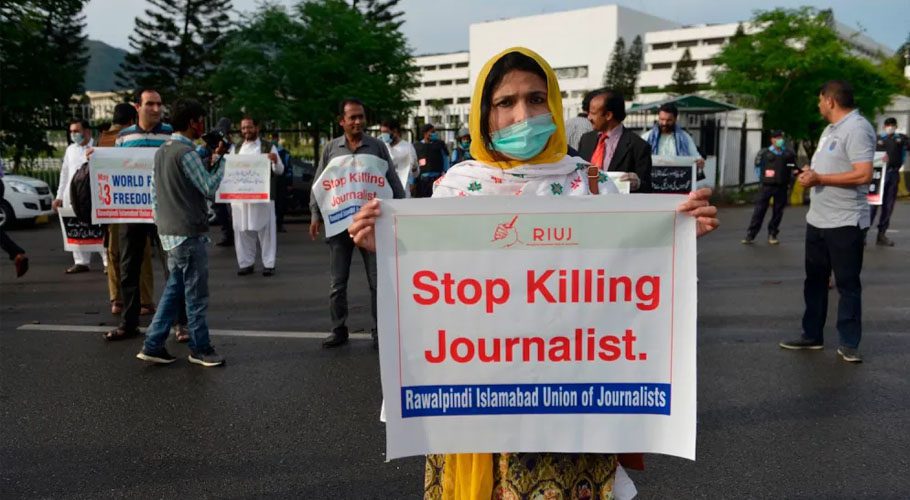
Press freedom in Pakistan has become a recurring theme of political hypocrisy and military interference. While political parties claim to protect journalists’ rights, the reality is far from it. Laws ostensibly designed to protect journalists’ freedom of speech are often used to suppress it. Private media outlets face a constant dilemma in balancing their independence with their dependence on state funding and the threat of censorship. Meanwhile, journalists in Pakistan face a dangerous environment, with unpunished murders and intimidation from military intelligence agencies, such as the Inter-Services Intelligence (ISI).
These revelations have been made in 2023 World Press Freedom Index released by Reporters Without Borders (RSF) on Wednesday.
The report, however, says despite harsh realities, Pakistan is several ranks ahead of India at 150th.
Also read: State Department opposes weaponization of blasphemy laws in Pakistan
Discussing political context, the RSF report says opposition parties in Pakistan support press freedom, but when they come to power, they often restrict it. Media regulators in Pakistan are controlled by the government, and they prioritize the defense of the executive over the public’s right to information. Journalists are not allowed to report on military and intelligence agency interference in politics due to the military’s increased control over civilian institutions.
The report indicates that Pakistani law is misused to suppress dissent under the pretext of protecting journalism. It says under the guise of protecting journalism, Pakistani law is used to censor any criticism of the government and the armed forces. The Pakistan Electronic Media Regulatory Authority (PEMRA), created in 2002, is concerned less with regulating the media sector than with regulating the content it publishes.
Also read: US panel urges removal of Pakistan’s religious freedom waivers
The Prevention of Electronic Crimes Act (PECA), adopted in 2016, is used more to restrict online freedom of expression than to crack down on online crime. As for the Protection of Journalists and Media Professionals Act, passed in 2021, said protection is conditional on reporters adopting a certain “conduct”. As a result of these ambiguously worded laws, journalists who cross the implicit lines dictated by the authorities are exposed to heavy administrative and criminal penalties – up to three years in prison for “sedition”, for example.
While discussing the economic aspect of Pakistan’s media, the RSF says privately owned media, especially local media, depend on state sector ads and legal announcements for funding, making them vulnerable to influence from information ministries. Those who challenge red lines face financial reprisals, and journalists may self-censor due to potential salary cuts during their employers’ financial difficulties.
Under the title ‘Safety’, the RSF report declared Pakistan as a dangerous place for journalists. It says Pakistan is one of the world’s deadliest countries for journalists, with three to four murders each year that are often linked to cases of corruption or illegal trafficking and which go completely unpunished. Any journalist who crosses the red lines dictated by Inter-Services Public Relations (ISPR) – an intelligence agency offshoot – is liable to be the target of in-depth surveillance that could lead to abduction and detention for varying lengths of time in the state’s prisons or less official jails. Furthermore, the Inter-Services Intelligence (ISI), Pakistan’s leading military intelligence agency, is prepared to silence any critic once and for all.