










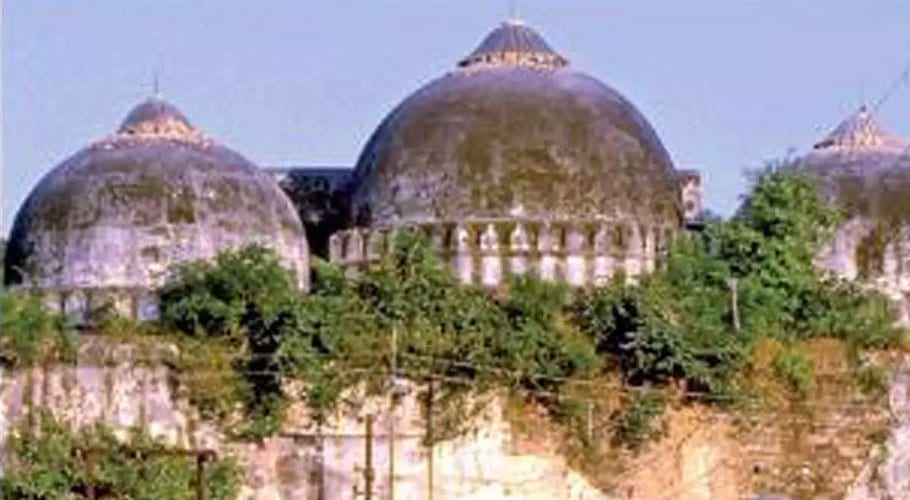
On 6 December 1992, the demolition of the Babri Masjid was illegally carried out by a large group of the Vishva Hindu Parishad activists and allied organisations.
The 16th-century Babri Mosque in the city of Ayodhya, in Uttar Pradesh India, had been the subject of a lengthy socio-political dispute and was targeted after a political rally organized by Hindu nationalist organizations turned violent. The rally turned violent, and the crowd overwhelmed security forces and tore down the mosque.
Background
In Hinduism, the birthplace of the deity Rama, known as Ram Janmabhoomi is considered a holy site. This place is often believed to be at the place where the Babri Masjid stood in the city of Ayodhya in Uttar Pradesh India historical evidence to support this belief is scarce.
There is a rough scholarly consensus that in 1528, following the Mughal conquest of the region, a mosque was built at the location by the Mughal general Mir Baqi, and named the Babri Masjid.
Role of British colonial administration
The site was used for religious purposes by both Hindus and Muslims for at least four centuries. The claim that the mosque stood on the site of a temple was first made in 1822, by an official of the Faizabad court.
The Nirmohi Akhara sect cited this statement in laying claim to the site later in the 19th century, leading to the first recorded incidents of religious violence at the site in 1855. In 1859 the British colonial administration set up a railing to separate the outer courtyard of the mosque to avoid disputes.
Idols of Rama placed allegedly
The status quo remained in place until 1949, when idols of Rama were surreptitiously placed inside the mosque, allegedly by volunteers of the Hindu Mahasabha. This led to an uproar, with both parties filing civil suits laying claim to the land.
The placement of the idols was seen as a desecration by the users of the Masjid. The site was declared to be in dispute, and the gates to the Masjid were locked.
In the 1980s, the Vishva Hindu Parishad (VHP) began a campaign for the construction of a temple dedicated to Rama at the site, with the Bharatiya Janata Party (BJP) as its political voice.
The movement was bolstered by the decision of a district judge, who ruled in 1986 that the gates would be reopened and Hindus permitted to worship there.
This decision was endorsed by Indian National Congress politician Rajiv Gandhi, then the Prime Minister of India, who sought to regain support from Hindus he had lost over the Shah Bano controversy.
In September 1990, BJP leader L. K. Advani began a Rath Yatra, a political rally traveling across much of north India to Ayodhya. The yatra sought to generate support for the proposed temple and also sought to unite Hindu votes by mobilizing anti-Muslim sentiment.
Demolition
The RSS organized a rally involving 150,000 VHP and BJP ‘kar sevaks’ at the site of the disputed structure on 6th December 1992. The mob set upon the building with axes, hammers, and grappling hooks, and within a few hours, the entire structure of the masque made from mud and chalk.
A 2009 report, authored by Justice Manmohan Singh Liberhan, found 68 people to be responsible for the demolition of the Masjid, mostly leaders from the BJP.
Investigation
December 1992: Later, the Union home ministry set up the Liberhan Commission to investigate the destruction of the Mosque, headed by retired High Court Judge M. S. Liberhan on 16 December 1992.
30 June 2009: After 399 sittings over sixteen years, the Commission submitted its 1,029-page report to Indian Prime Minister Manmohan Singh on 30 June 2009. According to the report, the events of 6th December 1992, in Ayodhya were “neither spontaneous nor unplanned”.
March 2015: In March 2015, the Supreme Court of India admitted a petition alleging that, with a BJP government in power, the CBI would not pursue conspiracy charges against senior BJP leaders including L. K. Advani and Rajnath Singh. The Court asked the CBI to explain its delay in filing an appeal.
April 2017: In April 2017, a special Central Bureau of Investigation court framed criminal conspiracy charges against BJP leaders Advani, Murli Manohar Joshi, Uma Bharti, Vinay Katiyar, and several others.
September 2020: On 30th September 2020, the court acquitted all the 32 accused including L.K Advani, Murli Manohar Joshi, Uma Bharti, Vinay Katiyar and several others in the case on account of inconclusive evidence. The special court judge said the demolition was not pre-planned.
Communal violence
The destruction of the Babri Mosque sparked Muslim outrage around the country, provoking several months of inter-communal rioting in which Hindus and Muslims attacked each other, burning and looting homes, shops and places of worship.
The riots spread to cities Mumbai, Surat, Ahmedabad, Kanpur, Delhi, Bhopal and several others, eventually resulting in over 2000 deaths, mainly Muslim.
The Mumbai Riots alone, which occurred in December 1992 and January 1993 and which the Shiv Sena played a big part in organizing, caused the death of around 900 people and estimated property damage of around 9,000 crores ($3.6 billion).
Justice in ruins following the case verdict
The ruins of the Babri Masjid were cleared in record time by the hordes of vandals mobilized for demolishing it. Some detritus was still left, though: a belief among many that justice would be done and the Constitution and the rule of law would be upheld if the criminal court punishes those who plotted the events of December 6, 1992.
Even when the Supreme Court handed over the empty site to those who wanted the mosque brought down to build a Ram temple, its recognition of the demolition as an egregious violation of the rule of law gave rise to hope that the ends of justice would be served by the punishment of those who mobilized the vandals.
Throwing to the winds the Supreme Court’s observations on the demolition, the trial court has in effect given judicial legitimation to the ‘Ram Janmabhoomi movement’ by acquitting all those indicted for conspiracy to bring down the structure.
The grave implications that the exoneration of those who demolished a religious structure would have on public trust in the judicial system, it is imperative that the CBI goes on appeal. The cause of communal amity cannot afford successive judicial setbacks to both secular values and the rule of law.
ADVERTISEMENT