










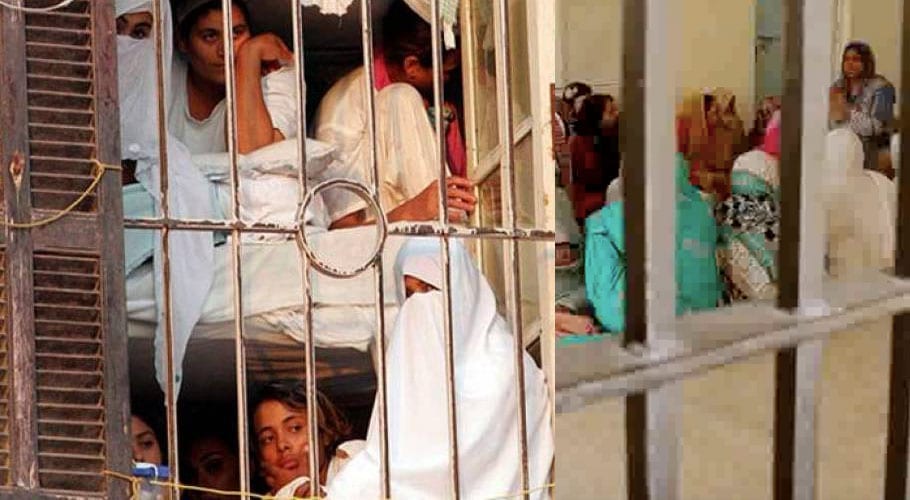
In light of the Supreme Court’s (SC) orders, Prime Minister Imran Khan on September 2 had directed the relevant authorities to make arrangements for the early release of female prisoners — both under-trial and convicted.
The order was issued after it brought to the notice of Prime Minister Imran Khan that a large number of women inmates were facing imprisonment only because they were unable to pay petty fines.
The prime minister directed the provinces and other authorities to generate funds through Baitul Mal and social welfare departments to pay fines of the women prisoners so that they could be released immediately.
The prime minister vowed that the government would bear all expenses for the release of women prisoners whose remaining sentence was less than three years and they were serving imprisonment due to non-payment of petty fines.
Supreme Court’s orders
In April 2020, the apex court had directed the government to release prisoners suffering from a physical or mental illness, under-trial prisoners who were 55 or older, male under-trial prisoners who had not been convicted in the past as well as female and juvenile prisoners.
The Supreme Court had recalled the bails granted to under-trial prisoners by the high courts’ of Sindh and Islamabad to prevent a coronavirus outbreak in over-crowded prisons.
However, it allowed the government to release prisoners who fell in the afore-mentioned criteria.
The prisoners included in the above categories had been spared on the counsel of the attorney general of Pakistan (AGP).
AGP proposals
The proposal said that accused persons charged for offenses under non-prohibitory clauses or under vagrancy law or offenses carrying less than three years sentence may be considered for bail.
AGP added that it should not be considered in cases involving abuse or violent acts against children and women, but persons suffering from ailments or disability should be considered.
The country’s chief law officer had said that bail should be considered in the case of UTPs who are 55-years-old or older, provided there is no history of past convictions and added that it should also be extended to all women and juvenile UTPs.
It also proposed that bail in these cases may be extended on personal bonds. Some categories of convicted persons may be considered for free by the provincial governments under Section 401 of the Code of Criminal Procedure (CrPC).
Furthermore, convicts who have completed their sentences, however, remained in jail due to non-payment of fine/monetary penalties and women/juvenile convicts who have served 75 percent of their sentence and have no history of past convictions can be released.
Convicts whose remaining term in jail is six months or less – provided that the offense was not abusing against women or children – and women, juveniles who are sentenced to a term of one year or less, may also be released on bail.
The prison population in Pakistan
A report of the Justice Project Pakistan (JPP) had disclosed in May that there were 77,275 inmates in Pakistani prisons against the authorized capacity of 57,742 prisoners in Sindh, Punjab, K-P and Balochistan. This is 34 percent more than the official capacity.
The report had further disclosed that there were a total of 1,204 females and 1,248 juveniles imprisoned in Pakistan. It further added that 83 mothers with 90 children were in different jails of Punjab and 37 mothers with 50 children in K-P.
Women with children represent a vulnerable section of Pakistan’s prison population who should be considered for immediate release in the wake of coronavirus, the report had suggested.
The report revealed that out of Pakistan’s total prison population (77,275), 65 percent of all inmates are currently undergoing trial.
This means that 48,008 inmates out of Pakistan’s prison population have not yet been convicted of a crime.
Female prisoners’ plight truly worrying
While male prisoners in Pakistan also suffer, the female prisoners’ plight is truly worrying.
Like male offenders, the majority of female offenders are poor. However, women enter the criminal justice system with a host of unique medical, psychological, and financial problems and needs that distinguish them from male offenders.
Addiction, poverty, unemployment, physical and mental illness, physical and sexual abuse, and homelessness trap women in a cycle of hopelessness and crime.
In particular, female offenders are often young mothers who face the additional trauma of threatened separation from their children.
Juvenile women offenders face additional difficulties. In the absence of a female probation officer, several juvenile offenders are in an extremely disadvantaged position.
Firstly, there is no separate section for female juvenile offenders. But on the other hand, they cannot be released on probation under the supervision of a male officer.
When women commit crimes, their children often become the innocent victims of the criminal justice system.
Women are exploited for many reasons, due to illiteracy, lack of control of resources, harassment at the workplace by the employer and male colleagues and many traditional practices make her vulnerable.
According to a report by the National Commission on the Status of Women an estimated 80% of women prisoners were in jail because they failed to prove rape charges, and found themselves locked-up in adultery convictions
More than 70% of women in police custody experience physical abuse including sexual abuse by their police officials.
Another report of the Human Rights Commission of Pakistan (HRCP) holds that Pakistani jails are severely overcrowded, where two-thirds of the prisoners’ population are waiting for their trials or are under trial.
Sadly, health and hygiene conditions have been compromised and facilities for mentally ill prisoners have been seen to be particularly poor.
Besides that food, clothing, lighting, exhaust system, beds and medical facilities for prisoners with mental challenges were also found wanting. Similarly, the social, moral, behavioral change and environmental conditions were not conducive for these prisoners to live in.
Need to redesign Pakistan’s prisons policy
The orders of early release of female prisoners by PM Khan had provided great relief to under-trial prisoners and their release should take place as quickly as possible.
To imprison a man is like imprison an individual, but to imprison a woman is to imprison a whole family. There is a dire need to redesign Pakistan’s prison policy to reform inmates.
At a time when there is a need for increased space for living, sports, educational, cultural and religious activities, need for segregation of prisoners, provision of free legal aid, upgrading parole and probation and a need for formal and technical skills, there is also an extreme need to revisit the bail laws of the country and bring reforms in the criminal justice system.
ADVERTISEMENT