











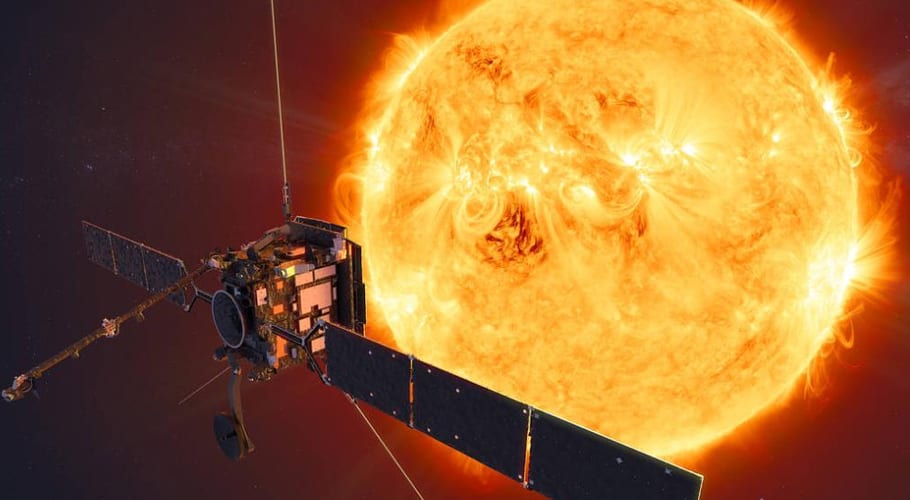
WASHINGTON: A new probe built by NASA and the European Space Agency set off on a blazing hot journey to the sun to take the first close-up look at the star’s polar regions, a mission expected to yield insight into how solar radiant energy affects Earth.
The Solar Orbiter spacecraft lifted off from Cape Canaveral, Florida, at 11:03 p.m. ET (0403 GMT Monday), kicking off a 10-year voyage. “This was picture perfect. And suddenly you really felt you are connected to the rest of the solar system,” Daniel Mueller, a scientist for ESA who worked on the mission, said after lift-off.
The mission controllers at the European Space Operations Centre in Darmstadt, Germany, received a signal from the spacecraft indicating that its solar panels had successfully deployed.
The minivan-sized spacecraft will deploy solar panels and antennas before carrying on toward the sun, a trek assisted by the gravitational forces of Earth and Venus. It will eventually reach as close as 26 million miles from the sun’s surface, or about 72 percent of the distance between the star and Earth.
Following #SolarOrbiter‘s 11:03pm ET launch, mission controllers received a signal from the spacecraft indicating its solar panels deployed successfully! ????????〰️???? Here’s what’s coming up next for the mission as it takes solar science to new heights: https://t.co/D9UJ4Ftbxh pic.twitter.com/zuUcjnWP4u
— NASA Sun & Space (@NASASun) February 10, 2020
Solar Orbiter is on a unique trajectory that will allow its comprehensive set of instruments to provide humanity with the first-ever images of the Sun’s poles. This includes 22 close approaches to the Sun, bringing the spacecraft within the orbit of Mercury to study the Sun and its influence on space.
“As humans, we have always been familiar with the importance of the Sun to life on Earth, observing it and investigating how it works in detail, but we have also long known it has the potential to disrupt everyday life should we be in the firing line of a powerful solar storm,” said Günther Hasinger, ESA director of Science.
“By the end of our Solar Orbiter mission, we will know more about the hidden force responsible for the Sun’s changing behavior and its influence on our home planet than ever before.”
3-2-1 LIFTOFF! ???? We have liftoff of #SolarOrbiter at 11:03pm ET atop @ULAlaunch’s #AtlasV rocket as the spacecraft begins its journey to snap the first pictures of the Sun’s north and south poles. Watch: https://t.co/W3wMEfPxvB pic.twitter.com/0F6Jk6vhML
— NASA (@NASA) February 10, 2020
Solar Orbiter will spend about three months in its commissioning phase. It will take Solar Orbiter about two years to reach its primary science orbit. “I have been in solar physics for many years; I just never thought I would actually witness something come to fruition like this and actually launch. It’s amazing,” said Holly Gilbert of NASA.
Solar Orbiter’s primary mission of examining the sun’s polar regions will help researchers understand the origins of solar wind, a soup of charged particles highly concentrated at the two poles, which blast through our solar system, affecting satellites and electronics on Earth.
The mission is also expected to glean insight into how astronauts can be protected from radiation in space, which can damage DNA. Solar Orbiter carries 10 instruments packed behind a massive 324-pound (147 kg) heat shield, three of which will peer through tiny windows to survey how the sun’s surface changes over time.
ADVERTISEMENT