








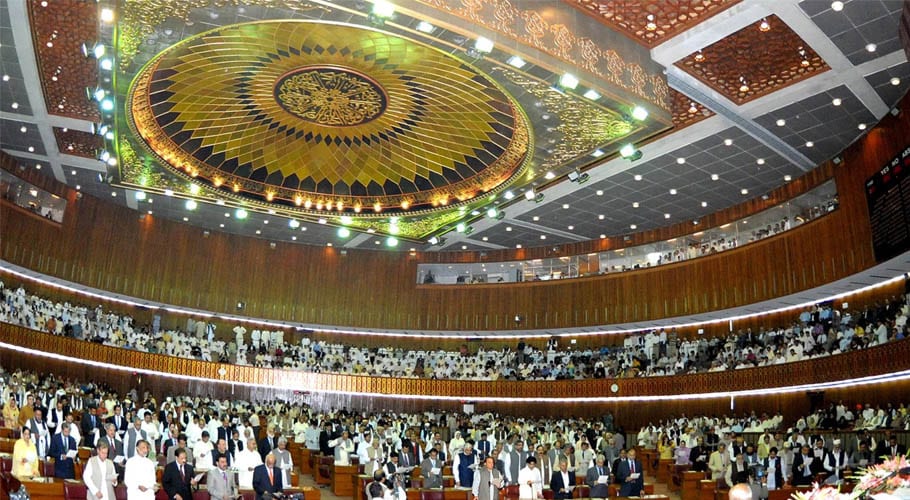
It has been almost 73 years since the creation of Pakistan and in this huge time span, Pakistan has been ruled by four dictators and several democratic governments. However, the debate of which is best for Pakistan is still on fire.
Today in Pakistan’s history (26 March 1969), General Yahya Khan enforced the second martial law on the country – which is being highly criticized by the democratic circles to date.
History says that on March 24, President Ayub pen downed a letter to General Yahya Khan to deal with the situation – Zulfiqar Ali Bhutto weakened President Ayub’s leadership. Then on 26th March General Yahya appeared on national television announced to enforce martial law.
Today marked 51 years of General Yahya martial law, at this stage the questions that arise are what dictatorship and democracy are? And what is best for the people?
What is Dictatorship?
Dictatorship – a form of authoritarian government in which the ruler or a group of rulers possess absolute power and are not restricted by any laws, constitutions and oppositions. In this type of government or social situation, the individual who possesses absolute power makes all the rules and decisions without input from anyone else and no one can oppose that. No freedom of speech exists in dictatorship.
Dictatorship in Pakistan
As above mention, Pakistan has witnessed four dictatorships in its history. All four served president of Pakistan for many years.
In 1958, General Ayub Khan rose to power and suspended the constitution which had been adopted two years earlier. He becomes president in 1960 and remained till 1969.
In 1969, General Yahya Khan succeeds after Ayub’s resign. Under the dictatorship of Yahya Khan, East Pakistan – Now Bangladesh – secedes in 1971.
In 1977, General Zia-ul-Haq launches military coup against Prime Minister Zulfiqar Ali Bhutto’s government. Zia-ul-Haq became president in 1978. In his leadership, Bhutto was hanged in 1979. He died in mysterious airplane crash in 1988.
In 1999, General Pervez Musharraf seizes power in coup. He became president in 2001 and remained till 2008 with a lot of conspiracies and operation under his leadership.
Current Example of Dictatorship
Dictatorship can be of many types and in the current scenario of the world, there are many countries where dictatorship is still present.
One of the biggest examples is North Korea, where people are still facing dictatorship. After the death of Kim Jong-il in Dec 2011, his son, Kim Jong-un inherited the political leadership.
In North Korea, there is no concept of information and broadcasting agency. The citizens can only hear and see government channels and radio.
Not only that but if you need a haircut you have to choose one of the approved styles of the President of North Korea.
What is Democracy?
Democracy may be a word familiar to most. In this regard, Abraham Lincoln – US President – once said, “Democracy is a government of people, by people and for people. Democracy is the government of people in which the supreme power is vested in people and exercised directly by them or by their elected agents under a free electoral system.
Democracy in Pakistan
Since independence in 1947, one of the most difficult challenges for Pakistan was to establish a truly democratic system. However, since 2008 general elections, Pakistan is under democratic rule. Pakistan has witnessed a more controlled democracy than the actual democracy.
If we see the history of Pakistan from 1988, then the first democratic rule would be witnessed. At that time, Pakistan People’s Party won the election. From 1988 t0 2007, these years Pakistan has faced the most political instability in its history. However, many journalists and political analysts still termed this democratic government as a controlled democracy.
Which System is better for Pakistan?
The decision can vary from person to person, but if we look at the consequences of the dictatorship and the positive nature of democracy with freedom of expression element, one can easily say that democracy is better than dictatorship.
However, the shortcomings of democracy in Pakistan need to be corrected. Failure of Democracy in Pakistan is just because of Feudalism, illiterate, self-imposed leaders and inherited politics.
Pakistani experts also have to keep an eye on the rule of democratic system and law in the country and they should work on the features of democracy and should improve and remove the flaws. Only then can we fulfill the dream of a better Pakistan.
ADVERTISEMENT