










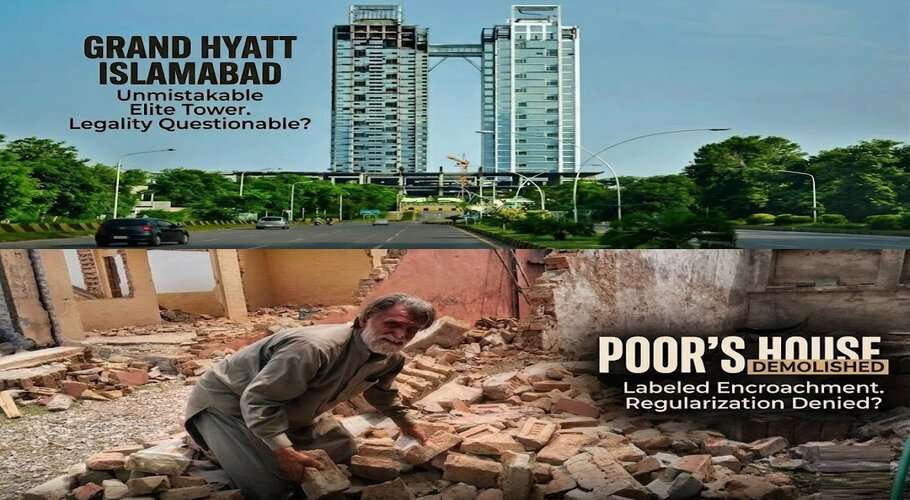
ISLAMABAD: The federal government is reported to be actively considering to compensate apartment owners of the controversial One Constitution Avenue project at their original purchase price has stirred fresh debate over unequal enforcement of urban laws, particularly when juxtaposed with recent demolitions in the capital’s oldest settlements.
A committee constituted by the prime minister has begun examining the legal and administrative dimensions of the project, with officials indicating that refunding investors at original rates is among the options under consideration. Headed by Law Minister Azam Nazeer Tarar, the body has been tasked with reviewing all related cases, hearing stakeholders, and proposing a course of action by May 8.
Interestingly, the One Constitution Avenue project itself traces back to 2005, when the Capital Development Authority (CDA) auctioned the plot for a planned five-star hotel. Prior to that, there is little public record of any such development being conceived for the site. Over time, however, the project evolved into a high-end residential complex, drawing scrutiny over alleged regulatory irregularities and approvals granted in deviation from initial plans.
Despite years of controversy and litigation, the structure continues to stand in one of Islamabad’s most prime locations. Notably, a recent attempt by the CDA to initiate eviction proceedings was halted following the prime minister’s intervention — a move critics say underscores the influence wielded by the project’s affluent residents.
In stark contrast, the CDA’s ongoing anti-encroachment drive in Bari Imam and surrounding localities has seen swift and sweeping demolitions. The area, which predates the creation of Islamabad, comprises centuries-old settlements, including what residents describe as “300-year-old model villages,” where generations have lived long before the capital’s 1960s master plan was conceived.
Since the start of the 2026 operation, authorities have bulldozed at least 14 historic villages and central markets around the Bari Imam shrine, with plans to clear more. Residents say the drive has effectively erased dense, informal neighbourhoods that evolved organically over centuries — often without formal documentation but with deep-rooted social and cultural ties.
Unlike the deliberative approach adopted for One Constitution Avenue, affected families in Bari Imam report receiving neither compensation nor alternative resettlement options. Many say they were evicted with little notice, their homes reduced to rubble within days.
Two Islambads: compensation for the powerful, bulldozers for the poor
The contrast has sharpened perceptions of a dual standard in the enforcement of planning and land-use laws — one that appears to favour powerful stakeholders while marginalising vulnerable communities.
Urban development experts argue that the issue goes beyond individual projects, pointing instead to systemic inconsistencies. “If irregularities are acknowledged in high-profile developments, the response cannot be limited to compensating investors. There must be institutional accountability,” a senior planner said, requesting anonymity.
As the committee deliberates the fate of One Constitution Avenue, the broader question remains whether Islamabad’s urban governance framework can reconcile legality with equity — or whether it will continue to reflect entrenched disparities between the city’s privileged enclaves and its oldest, yet most precarious, communities.