










WASHINGTON: President Donald Trump is expected to convene a Situation Room meeting on Iran later today (Monday), bringing together his top national‑security and foreign‑policy team to assess the fragile standoff with Tehran and chart the next steps in an escalating conflict.
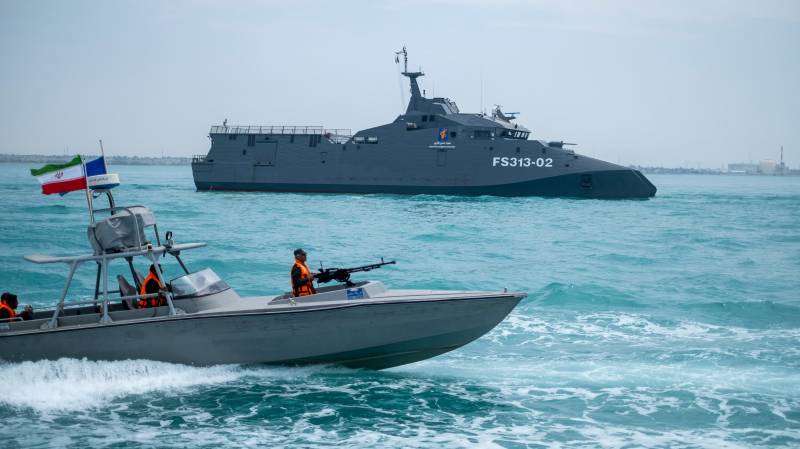
According to U.S. officials and reporting by Axios and journalist Barak Ravid, the meeting is expected to focus on the current stalemate in negotiations with Iran, including deep divisions within the Iranian leadership over nuclear‑related concessions and a new proposal mediated by Pakistan aimed at reopening the Strait of Hormuz.
https://archive.mmnews.tv/trump-tells-pakistan-army-chief-he-will-consider-concerns-over-hormuz-blockade/
Officials say the White House will also review potential options for the next phase of the war, weighing whether to increase military pressure, maintain the existing blockade and strike posture, or accept a limited deal that eases the Strait‑closure crisis while leaving broader nuclear tensions unresolved.
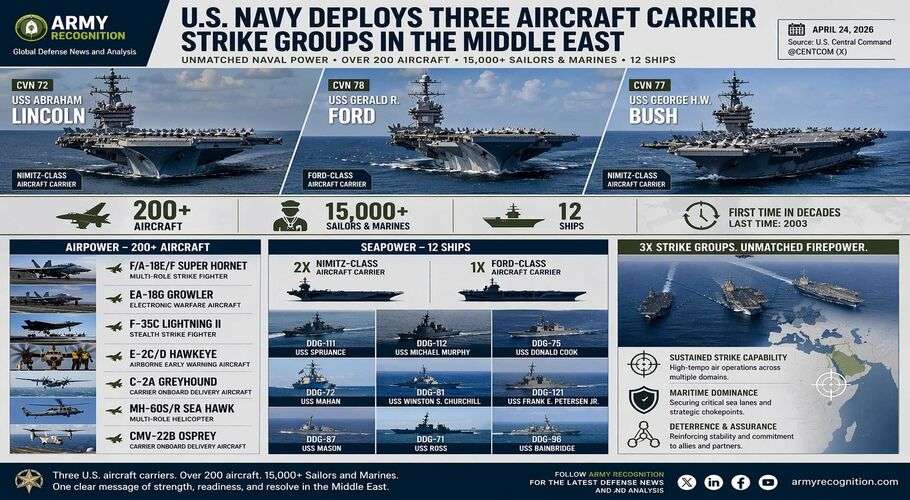
It is pertinent to mention here that these discussion comes against a backdrop of one of the largest U.S. military deployments in the Middle East since the 2003 Iraq War. Three U.S. aircraft carriers—USS Abraham Lincoln, USS Gerald R. Ford and USS George H.W. Bush—are now operating in the region simultaneously, marking the first time in over two decades that Washington has assembled such a carrier‑group cluster in the Middle East. Each carrier and its strike group are surrounded by a web of escort warships, with open‑source estimates suggesting roughly 846 missile‑launch tubes spread across nine destroyers, more than 200 aircraft across some 27 squadrons, and at least three fast‑attack submarines operating quietly beneath the waves.
Military observers have likened the current posture to the force package assembled ahead of the 2003 invasion, underscoring how Washington is using the threat of overwhelming conventional firepower to strengthen its hand in negotiations with Iran. At the same time, U.S. fuel‑tanker activity is increasing at bases in Jordan and Saudi Arabia, and there are reports of additional ground‑force elements being moved toward Kuwait, signaling a readiness to scale up operations if diplomacy fails.
Taken together, the Monday Situation Room session and the visible military buildup illustrate how the Trump administration is balancing the threat of escalation with a last‑ditch push to secure a deal that would reopen the Strait of Hormuz and cool, at least temporarily, the most dangerous phase of the U.S.–Iran confrontation in years.
https://archive.mmnews.tv/pakistani-army-chief-in-direct-contact-with-tehran-to-break-deadlock-al-arabiya/