










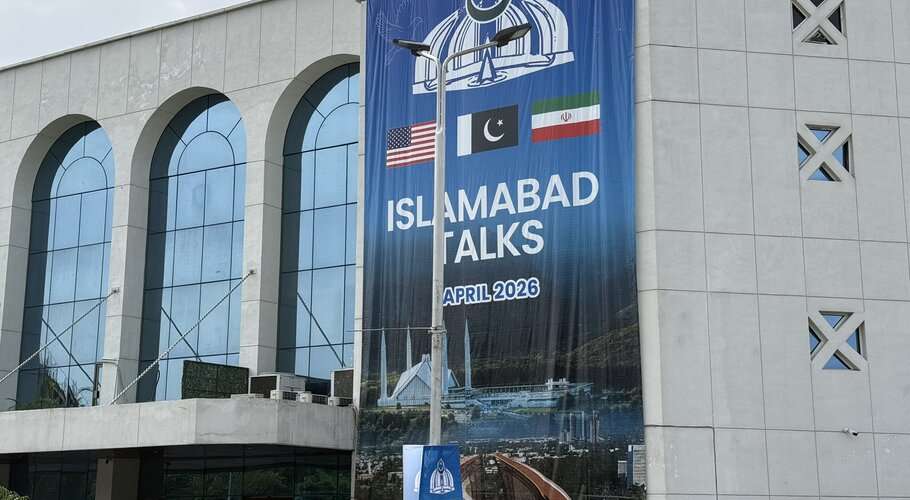
ISLAMABAD: In a day of high-stakes optics and feverish diplomacy, the federal capital on Saturday became the focal point of global attention as high-level delegations from the United States and Iran arrived for the much-anticipated ‘Islamabad Talks,’ aimed at de-escalating the six-week-old conflict in the Middle East.
The US and Iranian delegations were gathered for private meetings at a hotel in Islamabad. Iranian negotiator Mohammad Ghalibaf said he entered talks hopeful, with good intentions, but cautious, per Iranian state TV. @VP Vance told US reporters President Trump gave him “some…
— Jennifer Jacobs (@JenniferJJacobs) April 11, 2026
The arrival of US Vice President JD Vance earlier today was marked by a significant display of military and state protocol. Escorted by a formation of Pakistan Air Force (PAF) fighter jets upon entering Pakistani airspace, the Vice President’s aircraft touched down at Nur Khan Airbase, where he was received by Field Marshal Asim Munir and Deputy Prime Minister Ishaq Dar.
https://archive.mmnews.tv/jd-vances-plane-enters-pakistan-airspace-fighter-jets-scramble-as-iran-talks-loom/
The heavy-metal welcome for Mr. Vance followed the “wee hours” arrival of the Iranian delegation on Saturday morning. Led by Parliament Speaker Mohammad Bagher Ghalibaf and Foreign Minister Abbas Araghchi, the Iranian officials were similarly received on the tarmac by Field Marshal Munir and Deputy PM Dar, signaling Islamabad’s role as a balanced mediator in the crisis.
The two delegations have since retreated to a heavily guarded local hotel for a series of private consultative meetings. Speaking to Iranian state television shortly after his arrival, Mr. Ghalibaf struck a tone of guarded engagement.
“We enter these talks hopeful and with good intentions,” the Iranian negotiator stated, though he quickly tempered expectations by adding that Tehran remains “cautious” given the breakdown of previous diplomatic channels.
The American stance, meanwhile, appears to be one of “principled pressure.” Addressing a pool of US reporters accompanying him, Vice President Vance noted that President Donald Trump had provided him with “some pretty clear guidelines” for the negotiations.
“If the Iranians are willing to negotiate in good faith, the US will extend the open hand,” Mr. Vance said, echoing the administration’s transactional approach to foreign policy. However, he stopped short of specifying what concessions Washington might be prepared to offer in exchange for a permanent ceasefire.
Observers say the “Islamabad Talks” represent the first significant face-to-face diplomatic engagement between the two warring nations since hostilities escalated on February 28.
Sources within the Foreign Office suggest that while the delegations are currently housed in the same venue, the initial rounds may involve “proximity talks,” with Pakistani officials—including Mr. Dar and the military leadership—shuttling between rooms to bridge the trust deficit.
Meanwhilie, the federal capital remains under a strict security lockdown, with the “Red Zone” expanded to accommodate the movement of the foreign dignitaries.
https://archive.mmnews.tv/islamabad-traffic-adjusts-as-red-zone-expands-during-historic-us-iran-ceasefire-talks/
For Islamabad, the successful convening of these talks is being viewed as a major diplomatic win, positioning Pakistan as a rare bridge between Washington and Tehran at a time when the global economy remains roiled by the closure of the Strait of Hormuz and regional instability.