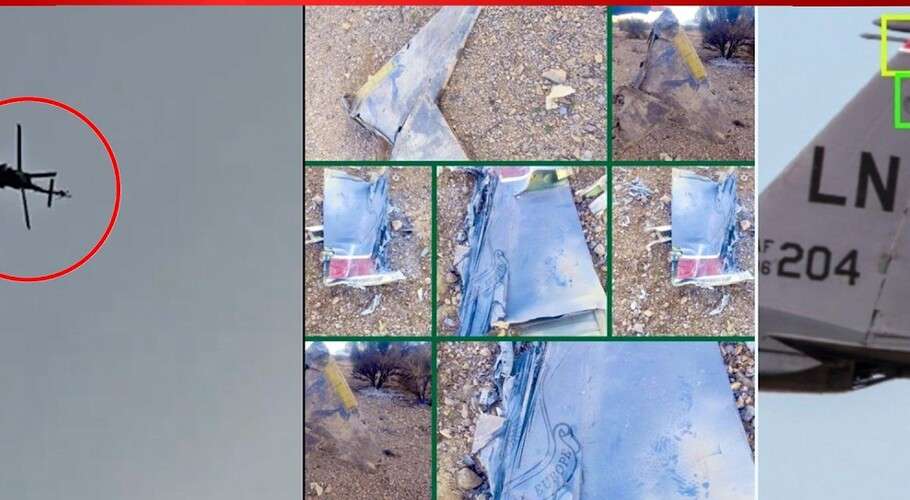
WASHINGTON / TEHRAN: The veneer of US air superiority over Iran was punctured during last 24-hour window of high-stakes aerial warfare, as Washington confirmed its first manned combat aircraft losses since the conflict began—a turning point that suggests Iran’s ‘degraded’ air defenses still possess lethal teeth.
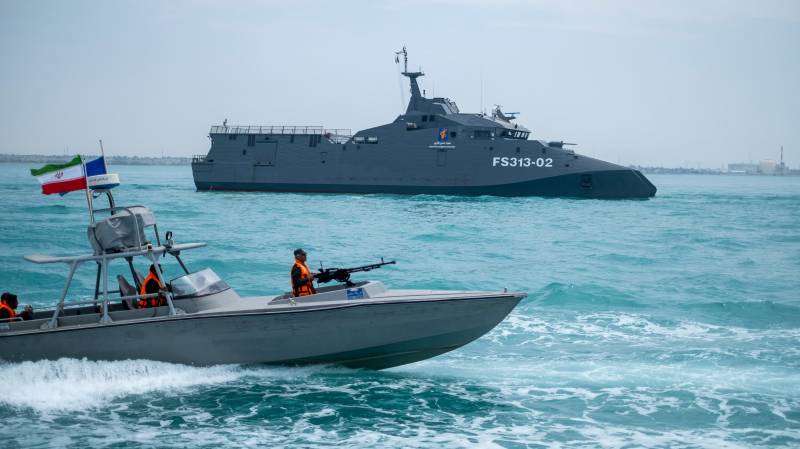
The day’s most significant escalation occurred over the rugged terrain of southwestern Iran when an F-15E Strike Eagle, the workhorse of the U.S. Air Force’s precision bombing campaign, was intercepted and shot down by the Islamic Revolutionary Guard Corps (IRGC).
While the U.S. Central Command (CENTCOM) initially remained tight-lipped, officials later confirmed that both crew members—a pilot and a Weapons Systems Officer (WSO)—successfully ejected. In a daring, high-risk extraction, U.S. Special Operations forces managed to rescue one crew member under the cover of a massive aerial umbrella, who is currently receiving medical treatment at an undisclosed U.S. facility.
The fate of the second crew member remains a flashpoint of tension. Iranian state media has broadcasted images of the wreckage, showcasing a red-striped vertical stabilizer consistent with the 494th Fighter Squadron. In a move reminiscent of historical guerrilla tactics, Tehran has offered rewards to local tribesmen in the Chaharmahal and Bakhtiari province to assist in the “hunt” for the missing airman.
As the search-and-rescue (SAR) mission for the F-15E intensified, a second blow fell near the Strait of Hormuz when an A-10 Thunderbolt II, affectionately known as the “Warthog,” went down in the Persian Gulf.
Reports suggest the A-10 was providing low-level cover for the ongoing SAR efforts when it was bracketed by Iranian fire. The lone pilot was successfully recovered from the water by a U.S. Navy team. Unlike the F-15E incident, the Pentagon has been quicker to confirm the pilot’s safety, though the loss of a second multi-million dollar airframe in a single day has sent shockwaves through the coalition.
The intensity of the American effort to recover its personnel was captured in viral social media footage. Videos showed HH-60 Pave Hawk and MH-60 Black Hawk helicopters, accompanied by an HC-130J Combat King II tanker, skimming the Iranian desert at “nap-of-the-earth” altitudes.
The mission was far from “surgical.” Two Black Hawks were significantly damaged by Iranian ground fire during the extraction of the first F-15E pilot. While initial rumors suggested a crash in Iraq, research and investigation by MM News confirms that both helicopters, though riddled with small-arms fire and carrying wounded personnel, managed to limp back to regional bases—likely in Kuwait or Iraq—without fatalities.
Propaganda or Hidden Hits? The F-16CJ Mystery
Adding to the fog of war, Iran’s Tasnim News Agency claimed a third victory, asserting that an F-16CJ “Wild Weasel”—specialized in suppressing enemy air defenses (SEAD)—was hit and forced into an emergency landing at a base in western Saudi Arabia.
“The enemy’s ‘Wild Weasel’ was tamed by our defenders,” claimed an IRGC spokesperson.
However, U.S. officials have categorically rejected this claim, with CENTCOM describing the F-16’s return as a “standard recovery” following a scheduled combat sortie. No independent verification or satellite imagery has yet emerged to support the Iranian claim, leading analysts to categorize it as a strategic information operation intended to capitalize on the day’s confirmed losses.
The events of April 3 signal a shift in the conflict’s gravity as for over a month, the U.S. had relied on its stealth and long-range standoff capabilities to avoid manned losses. By forcing U.S. assets into low-altitude, high-risk search-and-rescue corridors, Iran has demonstrated its ability to turn the “asymmetric” nature of the war in its favor.