










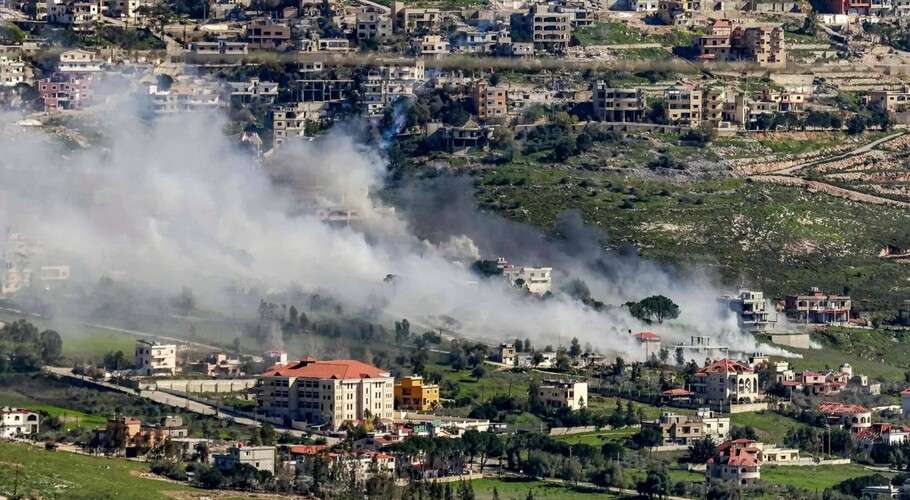
Israeli media reports suggest that a missile believed to be of Iranian origin struck an Israeli-designated site in southern Lebanon near the town of Khiam, marking what analysts say may be a new form of coordinated action between Iran and Hezbollah.
According to preliminary Israeli accounts, the projectile may originally have been a ballistic missile aimed at northern Israel but missed its intended target and impacted instead in the Khiam area. Other reports described the incident as evidence of an evolving pattern of joint operations between Tehran and Hezbollah under the broader “Axis of Resistance” framework.
Khiam has become a focal point of sustained clashes in recent days. The Israel Defense Forces (IDF) have carried out limited, targeted ground operations and repeated airstrikes in and around the town, while Hezbollah has claimed multiple rocket, missile, drone and small-arms attacks on IDF forces and positions in the vicinity — including areas east of Khiam, Hamames Hill and Wadi al-Asafir. The IDF says it has killed Hezbollah fighters and destroyed positions but continues to encounter stiff resistance.
The strike near Khiam comes amid intense cross-border exchanges and a separate Iranian ballistic missile barrage over the past 24–48 hours that struck southern Israeli towns, including Arad and Dimona near a nuclear research site. Those strikes caused significant damage and more than 100 injuries — dozens in each town, some serious — after Israel’s air-defence systems failed to intercept all incoming missiles.
The violence has exacted a mounting toll in Lebanon. Lebanon’s Ministry of Public Health, cited by multiple international outlets and updated on March 22–23, 2026, places the death toll from Israeli strikes and attacks since the escalation began on March 2 at roughly 1,024–1,029 people. Officials say casualties continue to rise as strikes, ground operations and bombardments persist across Beirut, the south, the Bekaa and other areas; more than one million people — roughly 20% of Lebanon’s population — have been displaced.
Israeli officials now confront pressure on multiple fronts: direct Iranian missile strikes from the east, sustained Hezbollah attacks along the northern border around Khiam and expanding IDF ground operations in southern Lebanon. Observers describe the situation as a two-front strain for Israel — fighting threats in southern Israel while conducting intensified operations across the border in southern Lebanon — with implications for regional escalation if coordination between Iran and Hezbollah continues to deepen.