










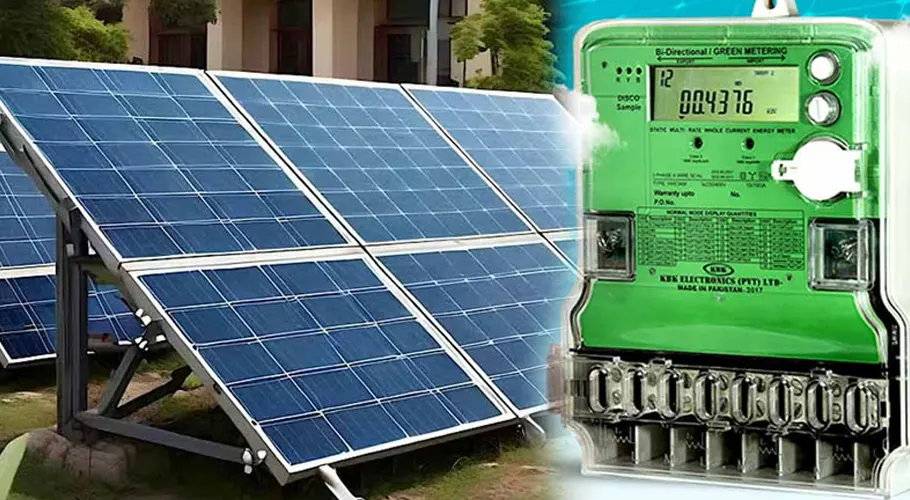
Pakistan’s National Electric Power Regulatory Authority (NEPRA) has officially ended the longstanding net metering system for rooftop solar and other distributed generation users, replacing it with a net billing (also called gross metering) framework under the NEPRA (Prosumer) Regulations, 2026.
The notification (S.R.O. 251(I)/2026) was issued on February 9, 2026, and took immediate effect, repealing the 2015 Net Metering Regulations.
Under the old net metering regime, solar prosumers (consumers who also produce electricity) received one-to-one unit credits: excess solar power exported to the grid offset consumption at the same retail rate (often Rs 40–50+ per unit for many households).
What is changing?
The transition from net metering to net billing fundamentally alters the economics of rooftop solar for Pakistani households and businesses.
| Feature | Old System (Net Metering) | New System (Net Billing) |
| Exchange Mechanism | One-to-one unit offset (Import = Export) | Units bought/sold at different prices |
| Buyback Rate | ~Rs. 26 – 27 per unit | ~Rs. 11 per unit (Approximate) |
| Contract Duration | 7 Years | 5 Years |
| Capacity Limit | Up to 150% of sanctioned load | Capped at 100% of sanctioned load |
| Settlement | Quarterly | Monthly |
The new net billing system separates imports and exports. Electricity drawn from the grid continues to be charged at the full applicable consumer tariff (which can exceed Rs 50 per unit in higher slabs).
Surplus electricity exported to the grid is purchased by distribution companies (DISCOs) at the National Average Energy Purchase Price, currently around Rs 11 per unit.
Payments for exported power are settled quarterly (every three months), rather than monthly offsets. New contracts are limited to 5 years, with a possible 5-year renewal; existing prosumers shift to net billing immediately (though some reports note existing contracts retain old terms until expiry, then transition).
The rules apply to solar, wind, and biogas systems up to 1 MW.
NEPRA and Power Division officials justify the change as necessary to address financial losses to utilities (estimated at Rs 101 billion in FY2024 due to reduced grid sales of 3.2 billion units), tariff distortions, grid instability from high solar penetration, and the unfair burden shifted to non-solar grid users, who faced average tariff hikes of about Rs 0.9 per kWh to absorb losses.
Critics argue the shift reduces incentives for renewables, slows adoption, and hurts consumers who invested in solar expecting long-term savings.
Existing users may see reduced benefits for exports, while new installations become less economically attractive given the wide gap between buyback (Rs 11) and retail rates.
This policy aims to protect the financially strained power sector but risks dampening Pakistan’s solar boom amid falling panel prices and rising grid tariffs.