











The White House said on Tuesday that President Donald Trump is discussing options for acquiring Greenland, including potential use of the U.S. military, in a revival of his ambition to control the strategic island despite European objections.
Trump sees acquiring Greenland as a U.S. national security priority necessary to “deter our adversaries in the Arctic region,” the White House said in a statement.
It is certain that a U.S. military seizure of Greenland from a longtime ally, Denmark, would send shock waves through the NATO alliance as Danish PM says it will be the end of NATO.
Meanwhile, France and Germany are reportedly working on a plan on how to respond should the United States act on its threat to take over Greenland.
President Donald Trump says US control of Greenland is necessary for national security https://t.co/xBk0ZVaUy0 pic.twitter.com/QF2aExkWSS
— Bloomberg (@business) January 5, 2026
Where is Greenland?

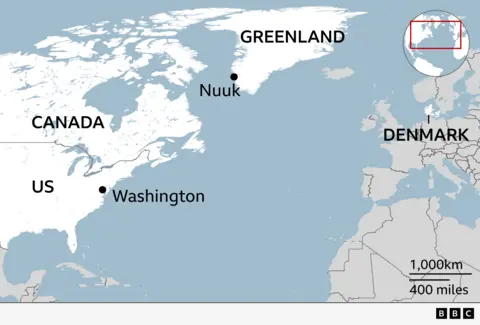
Greenland is an autonomous region in the Kingdom of Denmark, and is the largest of the kingdom’s three constituent parts. It is the world’s largest island, and lies between the Arctic and Atlantic oceans, east of the Canadian Arctic Archipelago.
This region holds exceptional importance in terms of mineral resources. It has large deposits of uranium, gold, oil, and gas, as well as rare earth minerals. According to the Geological Survey of Denmark and Greenland, the country is rich in rare metals, including 17 that are used in modern technology and the defense industry, such as drones, electric vehicles, and fighter jets.
Greenland also has deposits of graphite, lithium, and copper, which account for approximately 0.75% of the world’s total reserves. Lithium, a key component in batteries, is expected to see global demand increase eightfold by 2040.
Why does the U.S want to acquire Greenland?
The United States’ interest in Greenland is primarily based on its strategic importance, natural resources, and security considerations. Geographically, the island is also quite close to the U.S.
Greenland’s capital, Nuuk, is closer to New York City in the U.S. than to Copenhagen, the capital of Denmark. The distance between New York and Nuuk is approximately 2,900 km, while Copenhagen is about 3,540 km away.
Geographically, Greenland is located on a key defensive route between the Atlantic Ocean and the Arctic. The U.S. operates the “Thule Air Base” here, which serves as an important security checkpoint for the country’s air defense, missile defense, and space monitoring systems.
The U.S. considers this location crucial for monitoring increasing military activities by Russia and China. Greenland is about 5,000 km from Russia; however, in the Arctic region, the maritime borders of the two countries are relatively close.
Experts say that if Russia were to launch ballistic missiles at the U.S., the shortest trajectory would pass over Greenland. For this reason, America wants to install its new “Golden Dome” missile defense system here to protect itself from potential nuclear attacks.
The sea route between Greenland, Iceland, and the U.K., known as the “GIUK Gap,” is where Russian naval forces enter the Atlantic Ocean. Control over Greenland would allow the U.S. to monitor the movement of Russian submarines and ships.