










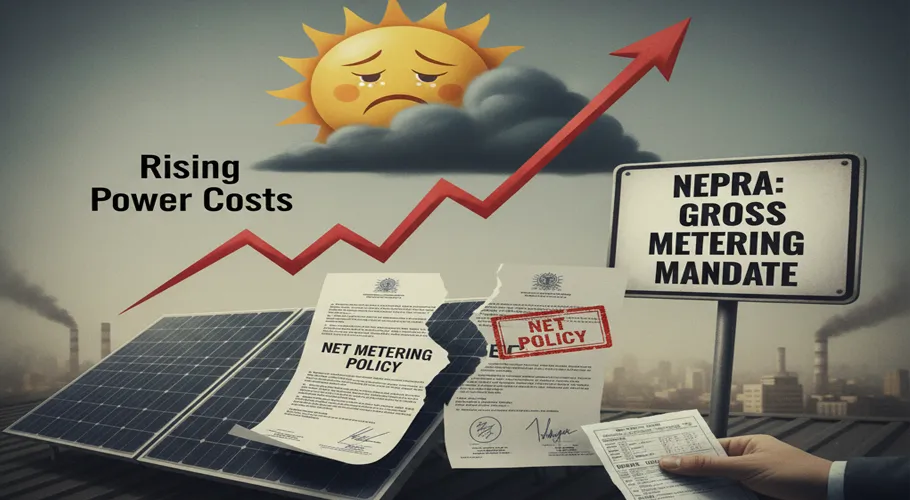
In a major policy reversal, the National Electric Power Regulatory Authority (Nepra) has proposed scrapping the existing net metering regime for new rooftop solar consumers and replacing it with a gross metering mechanism.
What is net metering?
Generate your own electricity and reduce your bills through the Net Metering program, in line with NEPRA’s Distributed Generation Regulations, 2015.
Under the draft Prosumer Regulations, future solar users will be paid a fixed feed-in tariff of Rs.11.30 per unit for electricity exported to the grid, while electricity imported will be billed separately at prevailing rates.
Existing consumers with valid seven-year agreements will remain protected until their contracts expire.
Nepra and the Power Division argue that net metering has imposed a financial burden on non-solar consumers, citing revenue losses of nearly Rs.101 billion in FY2024 and warning of much higher impacts in the coming decade.
Officials claim the grid is being used as a “free battery” by solar users and that the current buyback rate of Rs.22 per unit is unsustainable.
https://archive.mmnews.tv/net-metering-shock-govt-moves-to-cut-solar-buyback-rate-from-rs22-to-rs11-unit/
However, this abrupt backtracking reflects yet another instance of policy inconsistency, where the government shifts the cost of its own failures onto ordinary citizens.
سولر صارفین پر بجلی بم، نیٹ میٹرنگ کا فائدہ ختم،چھتوں پر لگایا گیا سولر بن گیا کباڑ؟ نیٹ میٹرنگ پر سنسنی خیز فیصلے!#SolarConsumers #ElectricityBomb #NetMetering #NetMeteringEnded #SolarEnergy #RooftopSolar #SolarPanels #SolarCrisis pic.twitter.com/uPffGTF9Yo
— GNN (@gnnhdofficial) December 22, 2025
Net metering was aggressively promoted to households as a long-term solution to rising energy costs.
Now, instead of fixing flawed planning, capacity payments, and disastrous take-or-pay contracts signed with power producers, the state is effectively penalising consumers for responding rationally to incentives it created.
Forcing the public to absorb the consequences of poorly negotiated agreements while rolling back clean energy reforms undermines trust, discourages investment, and exposes a deeper unwillingness to hold policymakers accountable for systemic failures.