










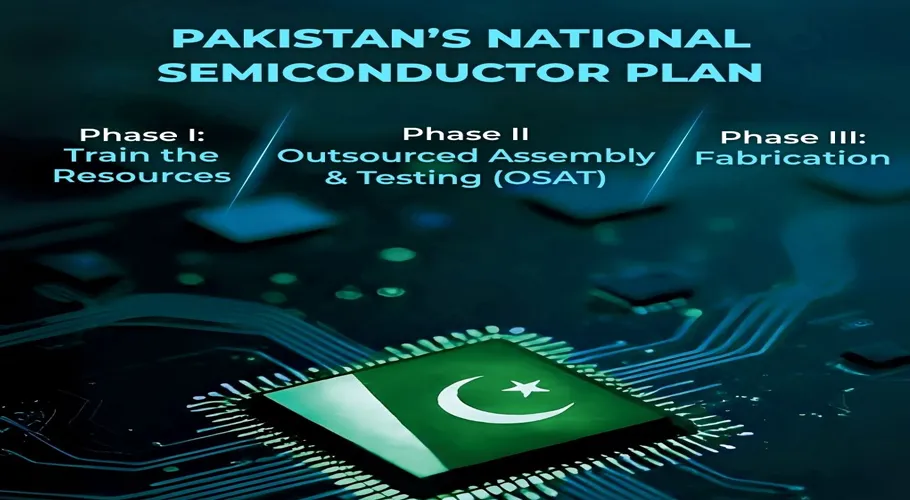
Prime Minister Shehbaz Sharif formally launched the National Semiconductor Program today, marking Pakistan’s entry into the global race for chip technology.
This arena is now deeply tied to rare earth minerals and strategic resource control, which is currently a world-leading focus of attention.
While Pakistan’s initiative focuses on chip design, training, and technology incubation, it also opens a door toward exploring the country’s untapped potential for rare earth minerals, particularly in Balochistan and Gilgit-Baltistan. These minerals form the backbone of semiconductor manufacturing, from microchip components to magnets and batteries.
Semiconductors and Rare Earth Minerals
Semiconductors are the ‘brains’ of modern electronics, used in everything from mobile phones and cars to defense systems.
Rare Earth Elements such as neodymium, dysprosium, yttrium, cerium, and lanthanum are essential in the manufacturing of:
- Chips
- Magnets and capacitors
- Displays and batteries
Without access to these minerals, no country can truly build a sustainable semiconductor ecosystem.
Why Does It Matter for Pakistan?
Pakistan currently doesn’t have a developed semiconductor industry, but the program aims to localize chip design, assembly, and training.
Pakistan’s Balochistan region and parts of Gilgit-Baltistan are believed to have untapped reserves of rare earth minerals, though these are not yet fully mapped. This gives strategic value to the new program, as it could attract foreign partnerships and exploration deals to support the semiconductor material supply.
Globally, semiconductor independence is becoming a new form of economic security. The United States, for instance, has partnered with Taiwan Semiconductor Manufacturing Company (TSMC) to open a $40 billion facility in Phoenix, Arizona, ensuring a steady, non-Chinese supply of advanced chips.
Pakistan’s new program, though at an early stage, places it within this shifting technological landscape where nations are redefining power not by oil reserves, but by control over silicon and rare earths.