











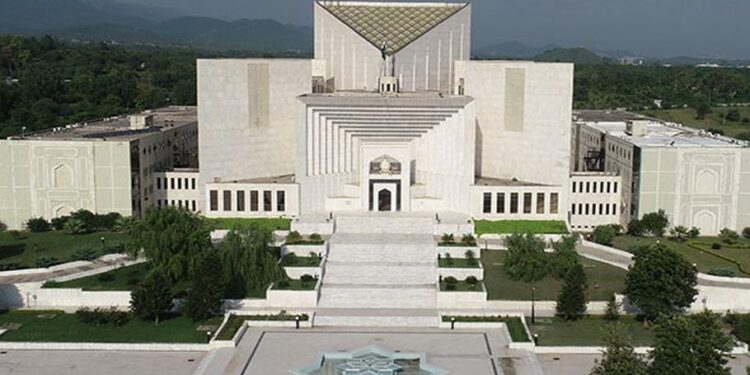
ISLAMABAD: The Supreme Court (SC) has overturned the death sentence of Anwar Keneth, a Christian man convicted under Pakistan’s blasphemy law, after medical evaluations confirmed he was suffering from a serious mental disorder at the time of the alleged offence.
A three-judge bench, headed by Justice Athar Minallah and comprising Justice Irfan Saadat Khan and Justice Malik Shahzad Ahmad Khan, ruled that Keneth could not be held criminally responsible due to his mental condition. The court found that his illness created serious doubt about his capacity to form criminal intent — or mens rea — required for conviction under Section 295-C of the Pakistan Penal Code (PPC).
Keneth, son of Veera Masih, had been sentenced to death by a Lahore trial court in 2002 for writing a letter deemed blasphemous. The Lahore High Court upheld the conviction in 2014, while the Supreme Court later converted his jail petition into an appeal in 2017.
During the proceedings, the apex court sought expert opinions from the Council of Islamic Ideology (CII) and ordered a detailed medical examination by the Punjab Institute of Mental Health (PIMH).
A medical board, headed by the Director General Health Services Punjab and comprising seven psychiatric and neurological specialists, diagnosed Keneth with Bipolar Affective Disorder. The report stated that he suffered from delusions and auditory hallucinations — believing he was chosen by God to become the “King of Israel.”
The experts confirmed that his writings and behaviour reflected symptoms of mania and delusional thinking. They also noted that while Keneth had not received psychiatric treatment at the time of the incident, his condition improved significantly after being admitted to PIMH in December 2024. By May 2025, he had stabilised under medication.
The Executive Director of PIMH and a psychiatry professor from King Edward Medical University appeared before the bench to confirm the findings, stating that the letter forming the basis of the case showed clear signs of mental disorder.
Justice Minallah observed that the content of the letter contained biblical references, grandiose ideas, and religious delusions consistent with a psychiatric illness. He also pointed out that despite signs of abnormality during investigation and trial, neither the prosecution nor the trial court sought a mental health evaluation.
The judgment highlighted that the prosecution’s evidence was weak — with only two witnesses produced and no testimony from the investigating officer — and reaffirmed that guilt must be proven beyond reasonable doubt, even when the accused fails to present a defence.
Concluding that the medical evidence created sufficient doubt about the presence of criminal intent, the Supreme Court ruled in favour of the appellant.
“The benefit of doubt is, therefore, extended in favour of the appellant,” the judgment stated.
The court set aside the verdicts of the lower courts, acquitted Anwar Keneth of all charges, and ordered his immediate release after more than 23 years in prison — most of it on death row.
The bench also directed PIMH to continue Keneth’s psychiatric treatment and ensure proper care.
Justice Minallah reaffirmed that executing or punishing a person suffering from a proven mental disorder would violate both the law and fundamental human rights, reiterating principles established in the landmark Safia Bano case.