










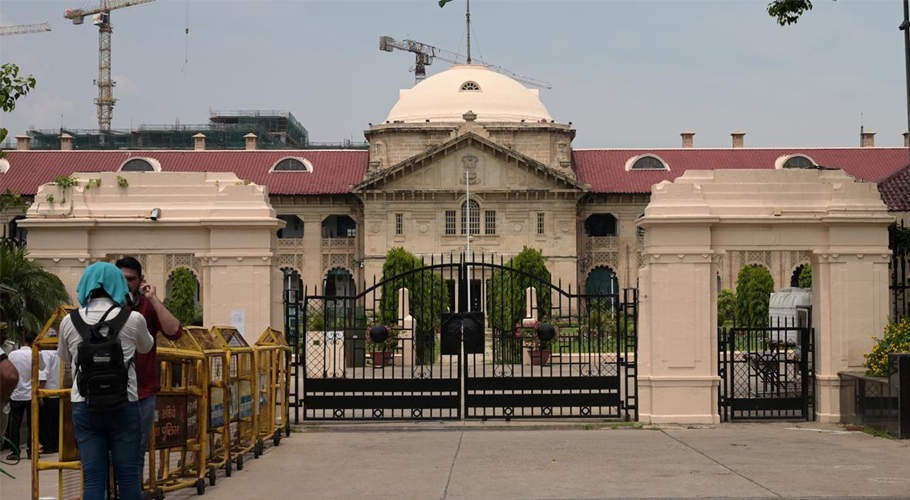
India’s Allahabad High Court, in compliance with the directive of the National Human Rights Commission, has ordered the Economic Offences Wing to stop the ongoing investigations regarding 558 aided madrasas.
According to details, while delivering this decision, the Division Bench of Justice Saurabh Srivastava and Justice Amitabh Kumar Rai directed the National Human Rights Commission to issue notices to the complainant and the petitioner, and further hearing of the case has been adjourned until November 17.
On the basis of a complaint by Muhammad Talha Ansari, the National Human Rights Commission had directed the Director General of the Economic Offences Wing to conduct an investigation into the matter. Following this, teachers of Madaris Arabia in Varanasi and two others filed a petition demanding the annulment of the National Human Rights Commission’s orders dated February 28, April 23, and June 11, which directed the Commission to investigate the allegations of the complainant and to submit an action report.
The petition also demanded the annulment of the government order dated April 23, under which the Economic Offences Wing, following the above directives of the National Human Rights Commission, has been conducting comprehensive investigations of 558 aided madrasas. It has been stated that the functions of the Commission are specifically mentioned under Section 12 of the Protection of Human Rights Act, 1993.
Notably, Section 36(2) of the Indian Act clearly states that the Commission will not investigate any matter after the expiry of one year from the date on which the violation of human rights is alleged to have been committed.
It has also been argued that under Section 12A, the Commission may conduct investigations suo motu, or on a petition presented by a victim or someone on his behalf, or on the basis of a directive or order of a court. In this case, none of the conditions under Section 12A apply. It is also stated that the complaint does not mention the date of violation of human rights. The allegations in the complaint are vague and do not indicate any specific date. Therefore, it is not possible to determine whether the complaint was made within one year of the date of violation of human rights. Hence, the entire proceedings of the Commission are argued to be beyond its jurisdiction.