











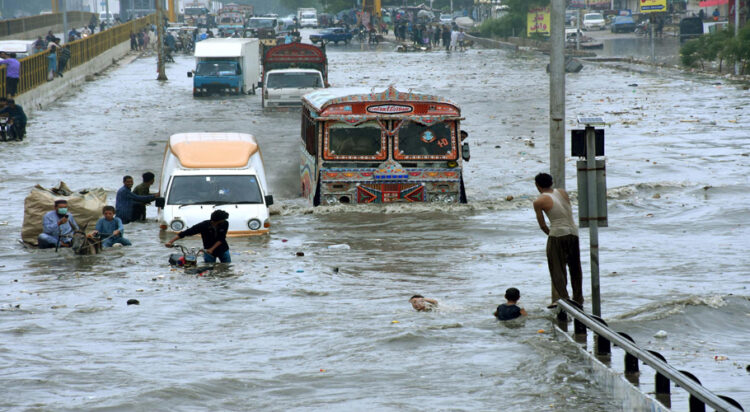
The Pakistan Meteorological Department has forecast more showers in Karachi today, warning of heavy rain accompanied by thunder and lightning in the afternoon. Some parts of the city could witness urban flooding due to intense downpours. However, the exact quantity of rain in millimeters or inches is not specified in the forecast.
As per the Chief Meteorologist Amir Hyder Laghari, the current spell of rain in the port city will continue until 23 August, while the city will receive more rain with thunderstorms today.
Schools and colleges in Karachi will stay closed for a second consecutive day today as heavy rains continue to disrupt normal life in the city.
The Sindh Education Department issued a notification confirming the closure of all public and private schools and colleges on Thursday.
Other districts of Sindh, including Hyderabad, Sukkur, and Mirpurkhas, are also likely to receive significant rainfall. The Met Department said the rain system would start losing strength from tonight, but low-lying areas remain vulnerable.
According to the National Disaster Management Authority (NDMA), 50 to 100 millimetres of rain may fall within hours, posing a severe risk of urban flooding due to poor drainage infrastructure.
Flash floods are feared in Thatta, Badin, Jamshoro, and Dadu, while rising water levels in the Indus River could threaten nearby settlements.
Wednesday’s rain spell claimed several lives and triggered urban flooding in the city. Different areas of Karachi received rainfall of varying degrees. Here are the details:
Orangi recorded the highest rainfall of 113 mm. Gulshan-e-Hadeed received 20 mm of rainfall.
University Road recorded 22.8 mm of rainfall. Keamari recorded 30 mm, and Jinnah Terminal recorded 28.2 mm of rainfall.
Old Airport recorded 20.5 mm, and Saadi Town recorded 15.2 mm of rainfall.
DHA recorded 20.5 mm of rainfall. Shahra-e-Faisal recorded 42.0 mm, and Surjani Town recorded 15.8 mm of rainfall.
Korangi recorded 29.2 mm, and Nazimabad recorded 19 mm of rainfall.
Masroor Base recorded 24 mm of rainfall, and Gulshan-e-Maymar recorded 6.4 mm of rainfall.