









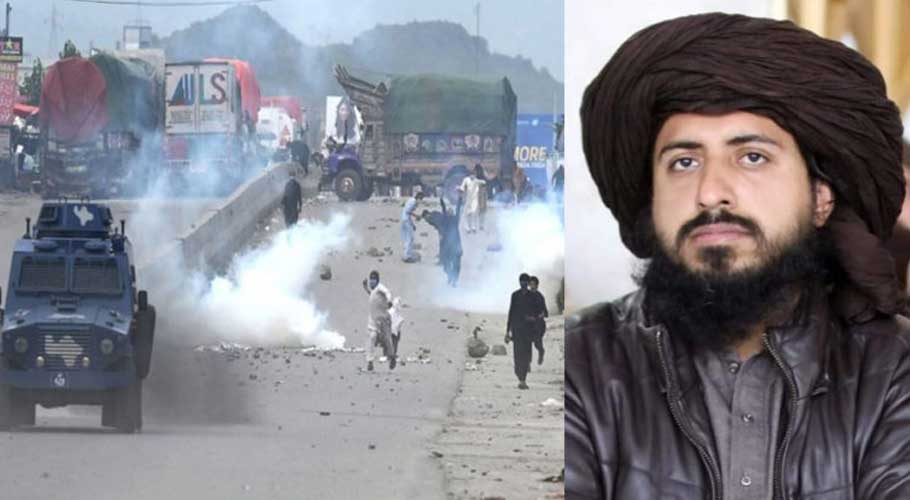
Tehreek-e-Labbaik Pakistan (TLP) has approached the interior ministry seeking review of the government’s decision of banning the party due to violent protests country.
The ultra-right wing party has submitted an appeal to the ministry to revisit its decision on April 15 to impose a ban on the party. Well-placed sources revealed the interior ministry has called a meeting to hear the appeal deliberate on the matter.
Let’s take an in-depth review of the government’s decision of banning the TLP and the party’s protests for the expulsion of French ambassadors.
The ban
The federal government, on April 15, formally banned the Tehreek-i-Labbaik Pakistan (TLP), whose supporters staged three days of violent protests across the country after the arrest of their leader. A notification declaring TLP as a proscribed organisation was issued by the Ministry of Interior.
TLP chief Saad Hussain Rizvi was detained as a “pre-emptive measure” ahead of the party’s April 20 deadline to the government. The deadline pertains to the party’s demands from last year.
In October, a history teacher who had shown blasphemous sketches of Prophet Muhammad (S.A.W.W) in class was decapitated and his assailant shot dead by French police as they tried to arrest him. Following the killing, French President Emmanuel Macron criticised Islamists and vowed not to “give up cartoons” depicting Prophet Muhammad.
The TLP had put forth four demands: the expulsion of the French ambassador over President Emmanuel Macron’s explicit backing of blasphemous cartoons, the release of party chief Saad Rizvi, the removal of the ban on the party and the release of activists arrested as well as the FIRs against them to be revoked.
Law for banning organization
Under Section 11B of ATA 1997, the federal government can proscribe an organisation if there are “reasonable grounds” to believe that it is concerned with terrorism. Further, under the ATA 1997, the federal government can take various measures against a proscribed organization, including sealing its offices and seizing all literature, posters, banners etc.
Section [11B] entails that reasonable grounds must be on the basis of information received from any credible sources including domestic or foreign including government, regulatory, or intelligence agencies.
However, the ban would be subject to Article 17(2) of the constitution which requires that any such declaration of banning a party has to be referred to the Supreme Court.
Was banning TLP the right decision?
The ultra-right TLP is a political party registered with the ECP. It contested the 2018 elections across the country and has representation in the Sindh Assembly. Can it then be technically classified as a terrorist organisation — although its workers have routinely unleashed violence that simply should not be tolerated at any cost?
A far better option would have been for the government to use its administrative and legal powers to hold the rioters accountable and make them face the law. The law should not spare a single violent worker of the TLP but banning it is no answer to the challenge.
It is an open secret that the TLP was nourished by the state for its vested interests. If today it has spiralled out of control, the blame lies with those who helped it grow into the threat it is today.
The ban will not dilute the narrative that fuels the party, it may even fan it. The government would be advised to take a more nuanced approach and desist from actions that are unlikely to produce the intended results.
Decision to lift the ban
The fact is that the state should not be forced and cannot be forced to give its writ away to any group. The fact also is that ban is not the solution. For this reason, Pakistan needs to develop a cohesive, holistic policy, which is agreed upon by all parties and is therefore acceptable to them in times of need.
The confusion that was created this time, the series of twists and turns, and the continuing lack of clarity for the next session of parliament do not help solve the problem and in fact only create greater uncertainty in the country.