











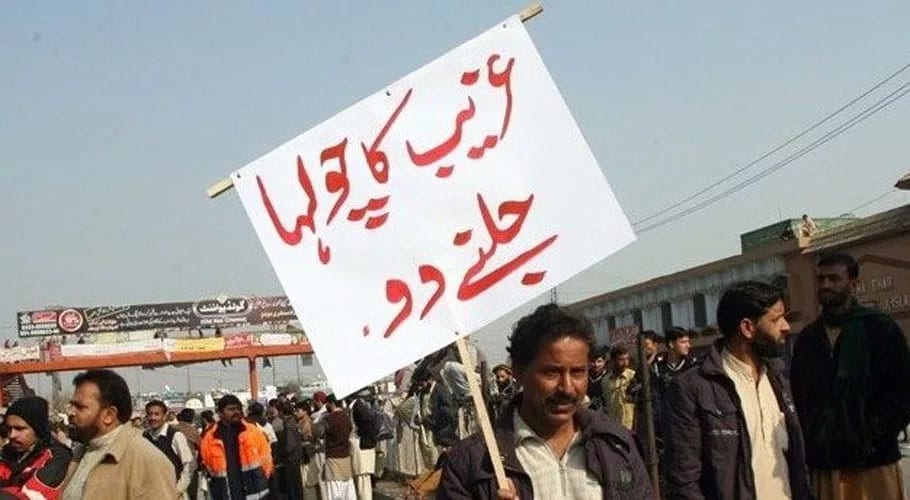
Amid ongoing controversy over gas shortages, the federal government has said the shortfall would almost double in the upcoming winter unless infrastructure constraints were phased out through the cooperation of the stakeholders concerned, particularly Sindh province.
The ministry of energy reported that gas shortfall was increasing due to about seven percent decline in domestic gas production and five percent growth in consumption when compared with last year, effectively creating a 12 percent gap between the demand and supply.
Karachi faces 960-970 mmcfd shortfalls
The Karachi is once again suffering from crippling power shortages causing as much as 12-hour outages in many parts of the city owing to extremely low gas production at SSGC fields causing a shortfall of as much as 960-970 mmcfd.
There is an acute shortage of natural gas for the past few weeks in many localities of the city. The gas shortage is making it impossible for families to have warm meals.
Sindh may face higher gas shortage
The federal government hinted that Sindh might face a higher gas shortage than other provinces of the country in the coming winter season and blamed the Sindh government for the possible closure of the industry and sufferings of the people, particularly in Karachi.
Special Assistant to the Prime Minister (SAPM) on Petroleum Nadeem Babar said the gas shortage in the Sui Southern Gas Company Limited (SSGCL) network, which serves Sindh and Balochistan provinces, was anticipated to touch 400 million cubic feet per day (mmcfd) which could be contained at 250 mmcfd if Sindh issued a right of way (ROW) for an additional gas pipeline.
Center blamed the Sindh govt for the gas crisis
Energy Minister, Omar Ayub blamed the Sindh government for lack of cooperation in extending the right of way to build a pipeline from Port Qasim despite raising the issue for the last one-and-a-half years.
The minister said the issue of gas supply had now gone beyond Article 158 of the Constitution that gave the right to the gas-producing provinces to use their gas first.
He said that a gas conference was held at the Prime Minister Office following the recommendation of the Council of Common Interests (CCI) for building a consensus on the weighted average gas price for supply from a common pool of local and imported gas.
The minister held the provincial government responsible for it. He said that at present SSGCL faced about 250 mmcfd of gas shortage which was being reduced by diverting 110 mmcfd of LNG. Otherwise, the situation would have been worse.
The minister said SNGPL would also be facing a gas shortage of 300-350mmcfd in the peak winter season and, therefore, there would be no possibility of diverting LNG to the SSGCL system. The minister said if the PPP government cooperates in giving the right of way to build the pipeline, the federal government is ready to complete the pipeline by the end of December this year.
He said Sindh was not ready to consume LNG, adding that the weighted average gas price was the only option. He held the PML-N government responsible for ignoring domestic gas exploration activities.
Sindh refutes the allegation
Sindh Minister for Energy Imtiaz Ahmed Sheikh had refuted a statement given by the federal Minister for Energy Umar Ayub Khan about the gas crisis.
Imtiaz said as per the statistics of the Petroleum Div¬ision gas production in the country was 3.94 billion cubic feet daily (bcfd), while Sindh produced 2.54 bcfd or 64.5 percent of the total. As per the statistics given by the federal government, Sindh uses 1.74 bcfd out of 2.54 bcfd it produces, he added.
The provincial energy minister said Sindh would not have much excess gas next year which could be provided to other provinces.
He said that supplying gas produced in Sindh to other parts of the country without the permission of the provincial government was a violation of Article 158 of the Constitution.
According to Sindh Information Minister Nasir Hussain Shah, Sindh supplies 68% of the country’s total gas but the province is being deprived to get it right.
Reacting to the federal government’s accusations of holding the Sindh government responsible for the gas outages in Karachi, the Sindh Chief Minister Syed Murad Ali Shah also ruled out the provincial government’s responsibility for the recent gas and power outages in Karachi, saying the federal government controlled the gas companies and responsible for the crisis.
Article 158 of the Constitution
In fact, the federal government is controlling power and gas- generating and distributing companies, and the center responsible to provide uninterrupted power and gas supplies. Just to hide their inefficiency, the governments were blaming each other, which was quite surprising.
Under Article 158 of the Constitution, the first right to provincial resources is that of the people of that province. If the province’s needs are met, the rest of the gas can be given to other provinces.
Governments need to tackle the issues
The situation demands that provincial and federal authorities sit together and find out a solution to the country’s gas shortage.
The distribution of gas as per the 18th Constitutional Amendment is one issue but the government needs to tackle the nation’s disturbing issue, growing losses of gas companies, line losses, the price mechanisms and import projects.
For the gas distribution among the provinces, the best forum is the Council of Common Interests, where the issue can be discussed and resolved.
ADVERTISEMENT