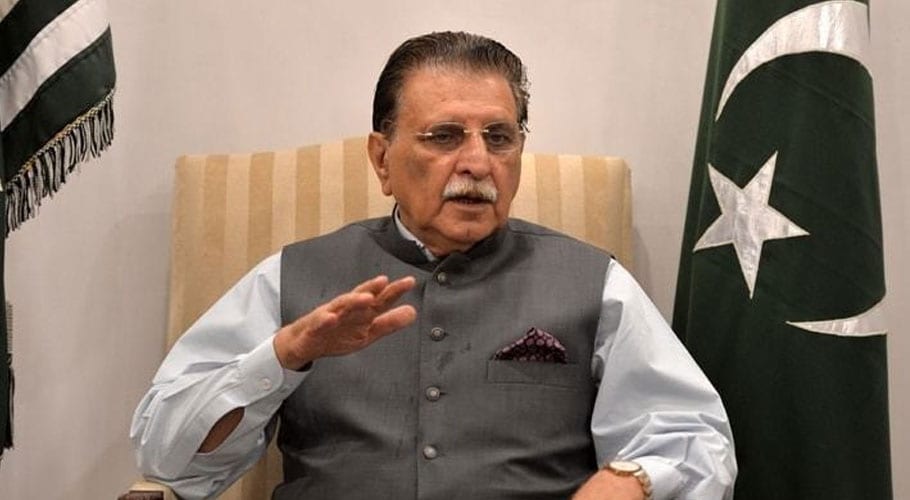
MUZAFFARABAD: Azad Jammu and Kashmir President Sardar Masood Khan has urged the medical fraternity to voice their concerns over the worst health crisis in Indian Illegally Occupied Kashmir (IIOJK).
The appeal came while addressing a gathering of over 500 doctors and senior health consultants from all the provinces at an annual mid-summer meet. The meeting was organized by the Pakistan Society of Internal Medicine (PSIM).
The event was also addressed by the President of PSIM, Professor Javed Akram, Senior Vice President Prof Aziz Rehman, Dr Somia Iqtadar, Prof Bikha Ram Devrajani, and others.
“The people of IIOJK are facing the worst health crisis of their history as the Indian occupation forces use pellet guns as a means to control the crowd and injuring them in the process,” he remarked.
The AJK president pointed out that IIOJK lacks healthcare staff, drugs, surgical material, and the equipment needed for healthcare. He also cited a report published by the Wall Street Journal which stated that hospitals in IIOJK have become graveyards because of a humanitarian crisis.
He also cited another report released by Doctors Sans Frontier (MSF), Sardar Masood said that some sort of mental distress, anxiety, depression, and post-traumatic stress disorder (PTSD) prevails among nearly 1.8 million Kashmiri adults.
“Children witnessing killings, physical torture, sexual abuses and destroyed properties before them are particularly suffering from PTSD,” the AJK president added.
He further said that the people of IIOJK were not only suffering from grievous eye injuries but have been denied access to communication, as well as all primary, secondary or tertiary healthcare hospitals.
Masood added that there were some good hospitals in the state, but the region lacked medical equipment and technology needed to fight communicable and non-communicable diseases.
He urged the doctors and medical experts to prepare themselves to embrace new technologies, like artificial intelligence, robotics and cloud computing, that have an impact on medical sciences to meet future challenges and compete at par with the world.
ADVERTISEMENT