










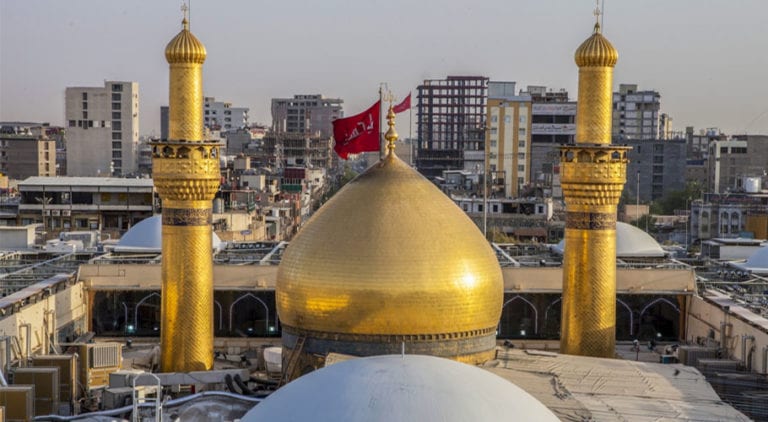
The Islamic New Year which started this week with the month of Muharram has once again returned Muslims worldwide to remember and relive a deeply agonizing memory.
Almost fourteen centuries after the massacre of Imam Hussain (AS), the grandson of Prophet Mohammad (PBUH) and 72 of his followers on the 10th day of Muharram at Karbala, southern Iraq, the memory of the tragedy continues to inspire Muslims worldwide.
The history of Muharram
Some fourteen centuries ago on the day of Ashura, the grandson of Prophet Muhammad, Imam Hussain and his little son, were ruthlessly killed in a cruel by an oppressive ruler in the Battle of Karbala.
Although Imam Hussain was slain in the battle, his message of kindness, justice and equality lives on among people who love him, and hence, that is his real victory.
The story of Karbala
The real story behind the mourning of Muharram is a very tragic one. On the 10th day of Muharram, also called Ashura, in the 61st year of the Islamic calendar, the fierce Battle of Karbala took place.
The battle was fought between a small group of supporters and relatives of Prophet Muhammad’s grandson Imam Hussain and a much larger military of Yazid.
Imam Hussain’s humble army comprised of only his friends and family, including women and young children. But they were surrounded by a heavily-armed enemy army of thousands.
They captured Hussain and his group and deprived them of water and food in the desert heat for three successive days. The cruel soldiers brutally killed Hussain and his 6-year-old son and took the women with them as captives.
It is a very emotional story and Muslims honor the sacrifice of the innocent lives by observing a mourning period in the month of Muharram.
The significance of Muharram
The month of Muharram is extremely holy for the Muslim community and Shia Muslims mourn the death of Imam Hussein and his family on this day of sorrow. They respect their sacrifice and pray in abundance as well as refrain from all joyous events.
The mourning period starts on the 1st day of Muharram and lasts for 10 days until the death day of Imam Hussein.
They mourn by putting on black clothes, observing abstinence, fasting and then they break their fast on the day of Ashura, the 10th day.
This painful observance is an expression of their grief on the death of their leader Hussain, also considered to be the representative of Allah.
But most people mourn in a more non-violent manner by holding sad processions, and by chanting “Ya Hussain”, wailing loudly. Ashura, the 10th day of Muharram also commemorates the day that Allah saved the Children of Israel from Pharaoh.
Lesson of Karbala
Hussain had to die because he alone refused to live in denial of the fact that Yazid was establishing a tyranny, one that he would not endorse even though a majority of those around him chose to look the other way. The lesson of Karbala is to stand up to oppression and coercion at all times.
The denial so prevalent in Pakistan today that no Muslim can indulge in causing the kind of death and destruction the Taliban and Al Qaeda are accused of unleashing on our cities must give way to the realization that a bigger enemy lurks within. It must not be allowed to cow us into submission.
Intolerance, extremism and the coercion the militants seek to impose on society must be condemned, stood up against and disowned.
Those who died in the desert of Iraq hundreds of years ago were innocent, just like those who die today when suicide bombers strike, killing and maiming our men, women and children. This tyranny, too, must be resisted.
Today, it is hardly surprising that Muslims worldwide facing unspeakable brutalities, from Palestine to Kashmir and elsewhere, rely on the example of Imam Hussain to repeatedly renew their commitment to fighting back.
Historical texts suggest that in the face of the numerically fewer souls on the side of Imam Hussain, the army of Yazid consisted of the strength of anywhere between 30 thousand and 70 thousand. It was indeed a massive overkill by Yazid.
Inspiration for the world
While we, the Muslims, debate on how to remember this epic tragedy when many of us fail to instill the lessons of Karbala in the minds of our younger ones and ourselves do not endeavor to understand and absorb the great philosophies of life imparted in a single day, those belonging to other faiths take inspiration from Hussain.
Mahatma Gandhi declared that “I learned from Hussain how to achieve victory while being oppressed”?
Charles Dickens honored Hussain’s spirit of sacrifice when he said, “It stands for reason, therefore, that he sacrificed purely for Islam”. The events of Karbala amazed Thomas Carlyle as he admits ‘The victory of Hussain, despite his minority, marvels me.’
After spending 20 years in prison, when Nelson Mandela was on the verge of surrender and was about to sign terms and conditions of his government, he suddenly remembered Hussain and the battle of Karbala and said ‘Hussain gave me the strength to stand for the right of freedom and liberation and I did.’
Ashura is a remembrance not for few, but for all. Not only for Muslims but for humanity. Ashura is not a tragedy, it is a celebration of the victory of good versus evil, right against wrong.
Ashura is not to be remembered at a certain time of the year, it is to be invoked at every occasion when faced with odds, it is to be a beacon of light when all hope is lost, it is the answer to every question asked in defiance of the truth.
ADVERTISEMENT