










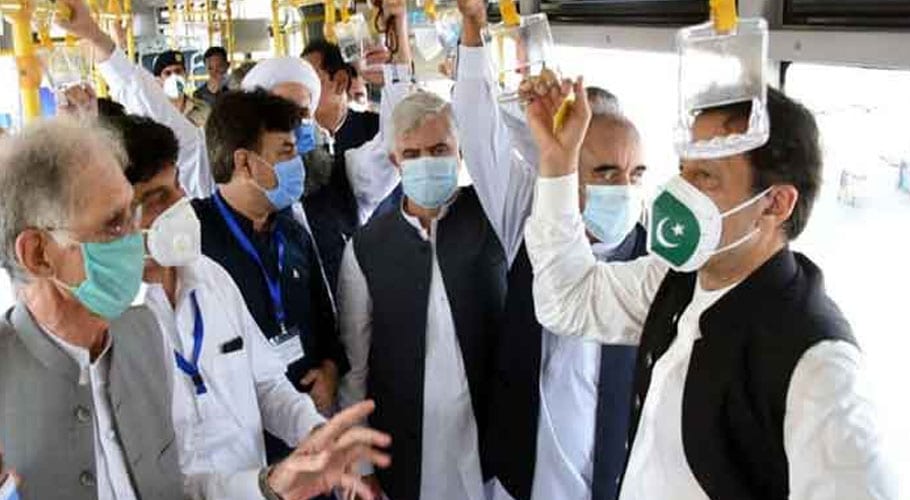
Prime Minister Imran Khan will inaugurate the flagship project of the Pakistan Tehreek-e-Insaaf’s (PTI) – the Peshawar Bus Rapid Transit (BRT) today (13th August). The BRT project is being dubbed as a ‘gift’ from PTI government for the people of Peshawar.
The multi-billion project will ensure a decent mode of transportation to the people of Peshawar within the city. This much-anticipated project is also indispensable in the provincial capital due to the growing population and traffic load.
Peshawar BRT project has been inordinately delayed. Despite several claims about the completion of the project, the PTI leaders had postponed the inauguration of the controversial project seven times. Let’s take an in-depth review of the controversial BRT project.
History
In 2013, the PTI’s Khyber Pakhtunkhwa government requested technical support from the Cities Development Initiative for Asia (CDIA) to improve Peshawar’s mismanaged and dilapidated urban transportation system.
In 2017, the CDIA completed the Urban Transport Pre-Feasibility Study that devised a 20-year urban transport plan, with a 10-year action plan.
The project was launched by former KP Chief Minister Pervez Khattak at the end of his tenure. Construction of the project, under the Peshawar Development Authority (PDA), began in 2017 and is being executed by the Peshawar Development Authority.
Project details
The BRT is a 27.5 kilometer-long main corridor track with 31 stations, besides seven feeder routes of total 62 kilometers with 146 stops to facilitate hundreds of thousands of passengers every day.
According to the PTI government, the BRT will bring revolution in the provincial capital’s transport system as approximately 340,000 common people will enjoy a safe, comfortable and affordable trip in luxury buses on a daily basis.
The government intends to collect fares via an automated ticketing system that is also intended to be used on all city routes. The minimum cost for a ticket will be 10 Rupees whereas the highest costing ticket will be 50 Rupees.
BRT Cost
The project was built with assistance from the Asian Development Bank (ADB). It was initially projected to cost ₨41 billion ($250 million), but its final estimated cost is approximately Rs71 billion (US$430 million).
Peshawar’s BRT is being dubbed, as one of the most expensive BRT. Here’s the cost comparison on a per kilometer basis: Ahmedabad $2.4 million; Dalian (China) $2.6 million; Changzhou (China) $4 million; Guangzhou (China) $4.4 million; Beijing $4.8 million; Bogota $5.3 million; Paris $7 million; and Istanbul $8.8 million. The cost of Lahore Metro came in at $11 million per kilometer.
Controversies and Allegations
In 2018, one of the asst. resident engineer resigned by saying that there is a lot of corruption going on in this project due to which it has been delayed.
However, the officials rejected the allegation and said that the assistant resident engineer was sacked from his job due to his ‘poor performance’ and ‘incompetence’.
A National Accountability Bureau probe ordered by the Peshawar High Court into the alleged corruption in the BRT project was stopped in Sept 2018 by a Supreme Court bench headed by the then chief justice, Saqib Nisar.
In April 2019, the Khyber-Pakhtunkhwa provincial inspection team submitted a detailed report on the Bus Rapid Transit (BRT) project to KP CM Mahmood Khan. The report estimated that some people received kickbacks totaling around Rs7 billion.
The team had found that the route was constructed without feasibility, geotechnical, sewerage, traffic, and water supply studies, among other reports, being undertaken before construction of the route.
The route, according to officials privy to the report, has eaten away at an average of 40 percent of available roadways on either side of the entire BRT route from its starting point to the endpoint.
According to report, the entire elevated section was miscalculated and that since there was no alternative for mixed traffic at BRT stations, at the traffic signals on the elevated sections, there will always be bottlenecks, causing immense traffic jams for mixed traffic.
However, KP CM criticised the inspection team for making Peshawar BRT report public and stated that flaws will be fixed, but rejected allegations of traffic bottlenecks caused by the operation of the BRT project.
Later in Dec 2019, the Peshawar High Court ordered the Federal Investigation Agency (FIA) to investigate that alleged corruption. The FIA team formed in line with the court’s judgment had submitted its report to the court at the end of January. However, the apex court stopped the probe in Feb.
ADVERTISEMENT