










Karachi is a megacity of more than 20 million people which is the economic heart of Pakistan and is rightly called mini-Pakistan.
The 20 million people of the city, the biggest and the most diverse city of the country have been suffering severe problems for a long time.
Power shortages, water scarcity, crime, transport, and environmental challenges are some of the major issues and the people of the metropolis seem to be trapped under the detrimental impacts of such life-threatening issues.
Not only have these issues engulfed Pakistan’s economic hub, but they have also pulled the helpless people of Karachi into a dilemma.
Rain becomes a nuisance in Karachi
The monsoon rain always becomes a nuisance instead of a relief from the scorching heat for the people of Karachi. The rain has increased the troubles of the citizens because many of the city’s areas drown in rainwater.
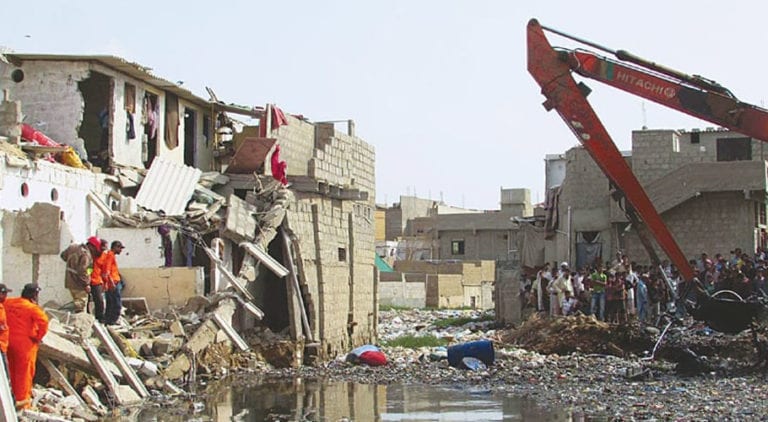
The rain caused a complete breakdown of urban life. Poor design and management of roads, drainage, intersections, underground sewers and sidewalks caused unparalleled chaos and damage.
Due to the over spilling of drains and the absence of properly directed flow of rainwater, streets, transitways and lanes were rendered unusable.
The Meteorological Department had predicted heavy rains in Karachi for two days from today. From today, 100 to 130 mm of rain is expected in the metropolis due to which urban flood is also feared.
Planning flaws
The mayhem exposed grave shortcomings in the planning, development and management of a city that houses over eight percent of the national population. Many factors contributed to this disappointing scenario.
There haven’t been any physical structures made for flood control nor investments made in the drainage system. Weak and inefficient urban infrastructure designs that don’t account for local topography and climate are also a reason for floods so often in the city.
Garbage and encroachment
Furthermore, the intermediary drains leading to big nullahs which are themselves far in between also full of garbage or encroached upon, leaving no path for any accumulated water to head to the nullahs.
As the city expanded in a haywire manner, the stormwater drains were transformed into sewerage trunks. Even the planned neighborhoods had their primary sewerage conduits ejecting into the nallahs.
Over the years, land grabbers and builders recklessly constructed structures on, and along, the nallahs. With the irregular reclamation of nallahs’ banks, the width of the water stream decreased.
This created a perpetual problem both for the usual flow of sewage and the rainwater during monsoons. In certain cases, these constructions made the maintenance of nallahs impossible.
Sindh government
For the last 12 years, the PPP was in power in Sindh. People of the province were crying due to a lack of basic necessities.
Over the years we have seen one agency blame the other. More recently with the provincial government headed by the PPP and the federal government run by the PTI, the blame game has reached new proportions.
Earlier it was the MQM blaming the PPP. Now the war of words is between the PPP and the PTI. The Karachi resident suffers throughout.
According to the Sindh government, Karachi Metropolitan Municipality and other local bodies are responsible for cleaning drains in the metropolis.
On the other hand, Mayor Karachi Wasim Akhtar either suppresses the issue by responding to the lack of authority and funds for cleaning the drains, acquits himself by placing responsibility on the Sindh government.
National Disaster Management Authority
The National Disaster Management Authority (NDMA) and Frontier Works Organisation (FWO) continued the large-scale cleaning of Karachi nullahs for the fourth consecutive day on Prime Minister Imran Khan’s directives.
Earlier, Prime Minister Imran Khan had directed the NDMA chairman to visit Karachi and begin cleaning up the city.
The premier signed a summary authorizing NDMA and the Frontier Works Organisation (FWO) to carry out a cleanliness drive in Karachi with “unlimited funds” and the long-term role of the federal and military organizations.
NDMA had started cleaning 22 out of 38 major drains (mullah) in Karachi on an emergency basis. There are a total of 552 small and large storm drains in Karachi.
In a few days’ efforts, more than 10,000 tons of garbage has been removed from the drains, after which the condition of these drains has improved a lot. After which it hoped that the citizens of Karachi will not face the same situation as before in the coming rains.
If the prime minister restores the status of Karachi as a model city, he will succeed in winning the hearts of Karachiites and in turn, see the positive result of his efforts during the upcoming local bodies and next general elections.
Cleaning of nullahs by NDMA not a permanent solution
There was dire need to resolve the city’s issues on an urgent basis. Laws could be amended and a special package should be announced for Karachi. Cleaning of nullahs by NDMA not a permanent solution as the garbage was still being dumped in nullahs.
Cleaning of drains and the prevention of sewage water from entering the houses of people is possible only with the joint efforts of KMC and the Sindh government.
KMC and the Sindh government must be ensured that thousands of tonnes of garbage may be disposed of on a daily basis and arrangements be made to recycle it for power generation.
The sewerage system of almost 80 percent of the metropolis has gone out of order and there is a great need to lay down a new and long-lasting sewerage system to get rid of the choked sewerage lines which result in overflow of sewage water.
Many roads, including busy roads such as Landhi, M. A. Jinnah Road, Sharea Faisal, Jahangir Road, Nishtar Road, etc., badly need to be leveled up and re-carpeted, for after each heavy shower, they become inundated with rainwater mixed with the sewage water.
Clean drinking water supply to Karachiites is another severe issue and it needs to be resolved on a permanent basis.
ADVERTISEMENT