









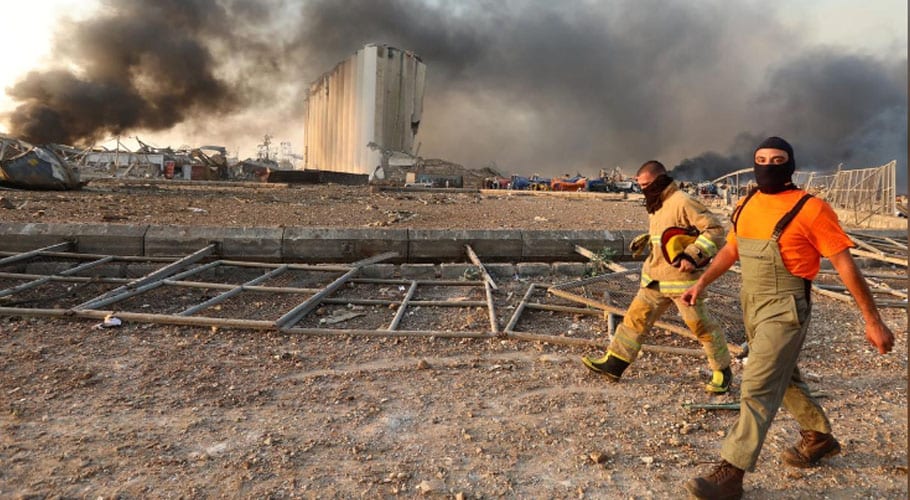
BEIRUT: Lebanese rescue workers dug through the rubble looking for survivors of a powerful warehouse explosion that shook the capital Beirut, killing 78 people and injuring nearly 4,000.
The blast at port warehouses storing highly explosive material was the most powerful in years in Beirut, already reeling from an economic crisis and a surge in coronavirus infections.
President Michel Aoun said that 2,750 tonnes of ammonium nitrate, used in fertilisers and bombs, had been stored for six years at the port without safety measures. He called for an emergency cabinet meeting on Wednesday.
Officials did not say what caused the blaze that set off the blast. Local media said it was started by welding work being carried out on a hole in the warehouse.
Hours after the blast, a fire still blazed in the port district, casting an orange glow across the night sky as helicopters hovered and ambulance sirens sounded across the capital.
The blast revived memories of a 1975-90 civil war and its aftermath, when Lebanese endured heavy shelling, car bombings and Israeli air raids, while ome residents thought an earthquake had struck.
Prime Minister Hassan Diab promised there would be accountability for the deadly blast at the “dangerous warehouse”, adding “those responsible will pay the price.”
The US embassy in Beirut warned residents about reports of toxic gases released by the blast, urging people to stay indoors and wear masks if available.
“There are many people missing. People are asking the emergency department about their loved ones and it is difficult to search at night because there is no electricity,” Health Minister Hamad Hasan told a news agency. Hasan said 78 people were killed and nearly 4,000 injured.
Footage of the explosion shared by residents on social media showed a column of smoke rising from the port, followed by an enormous blast, sending a white cloud and a fireball into the sky. Those filming the incident from high buildings two kilometres from the port were thrown backward by the shock.
Bleeding people were seen running and shouting for help in clouds of smoke and dust in streets littered with damaged buildings, flying debris, and wrecked cars and furniture.
The explosion occurred days before a UN-backed court is due to deliver a verdict in the trial of four suspects from Hezbollah over a 2005 bombing which killed former Prime Minister Rafik al-Hariri and 21 others. Hariri was killed by a huge truck bomb on the same waterfront, about 2 km from the port.
Israel said it has nothing to do with their blast and said the country was ready to give humanitarian and medical assistance. Iran also offered support as did Tehran’s regional rival Saudi Arabia.
At a White House briefing, US President Donald Trump indicated that the explosion was a possible attack, but two US officials said initial information contradicted Trump’s view.
ADVERTISEMENT