










The stock market plays a very important role in economic development. The inefficiency of the stock market is one of the most serious limiting factors in underdeveloped countries. The stock market occupies the central and strategic position in the process of economic development of a country.
Without having a fully developed stock market, a country will not be able to increase the availability of equity funding and move towards more balanced financial structures.
When people draw their savings and invest in shares, it leads to more rational allocation of resources because funds, which could have been consumed or kept in idle deposits with banks, are mobilized and redirected to promote business activity with benefits for several economic sectors such as agriculture, commerce and industry, resulting in stronger economic growth and higher productivity levels and firms.
Barometer of the economy
At the stock exchange, share prices rise and fall depending, largely on market forces. Share prices tend to rise or remain stable when companies and the economy in general show signs of stability and growth. An economic recession, depression, or financial crisis could eventually lead to a stock market crash. Therefore the movement of share prices and in general of the stock indexes can be an indicator of the general trend in the economy.
Comprehensive exercises for trading
PSX management, over the last two weeks, under the guidance of the SECP, and in close coordination with its associated companies and SROs, NCCPL and CDC, had undertaken and enacted comprehensive exercises of trading and technology functionality, risk management process drills and administrative protective steps to ensure business continuity and safety for its employees, TREC holders and investors.
Trading session
Pakistan Stock Exchange (PSX), the premier Capital market Institution of the country, cognizant of its role as a front line regulator working for the benefit of its stakeholders, successfully operated its trading session during a month, thereby facilitating investors, TREC holders and market participants.
The various business functions of the Stock Exchange including trading, settlement, clearing, risk management and IT worked seamlessly and there were no operational or settlement issues encountered, despite the challenges on account of the economic scenario, lockdown due to the potential threat of the spread of the COVID-19 and terrorist attack.
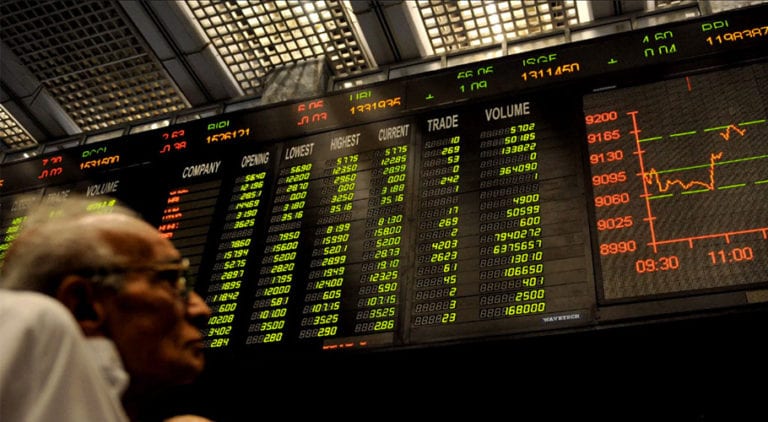
The market remained positive for the fourth consecutive week as the benchmark KSE-100 index closed 179.37 points as trading resumed reaching the highest mark in intra-day trading at 37,928.87 points.
Performance of KSE in July
Stock market performance remained positive from 1st July 2020, the turnover increased by 467.49 points. The market closed at 34,889 points on July 2, a slight increase of 88.77 points was noted in the business.
Due to the positive trend, the KSE-100, the index increased by 73.20 points on July 3 which crossed the level of 35,000 points. An increase of 151.39 points was recorded on July 6, while an increase of 170.58 points was recorded on July 7.
On July 8, the KSE-100 increased by 321 points, with the market crossing the psychological level of 35,500. Overall the business closed at 35,694 points. During the trading session on July 9, the market rose by 447 points to 36,142.
During the trading session on Tuesday, July 21, the KSE 100 index surged by 179.37 points as trading resumed reaching the highest mark in intra-day trading at 37,928.87 points.
The indices slipped by 271.41 points reaching the lowest level at 37,368.52 points. The bourse eventually settled with a gain of 49.74 points at 37,700.31 points. The total volume of shares was 277.055 million valued at Rs15.425 billion.
Improvement need in creditability of information
K.S.E is driven by speculative sentiments and insider trading has been ruling the market, which has often resulted in price volatility as well as price manipulation.
The market’s response to fundamental investment-oriented events has been dismal and less significant. It is suggested that the K.S.E should improve the quality, quantity and creditability of information companies discloses to investing public.
The information may address the diversification, investor’s participation and minimization of unanticipated practices. Such a policy may protect the small investor’s interest that is always issued for developing and emerging stock markets.
Although the current rally has recouped much of the losses and the Index is back in the green after three bad years. Most expect the market to remain positive in the upcoming week on the back of improving macroeconomic numbers, drop in fixed income yields, stable exchange rate which has been so for the past four months and a positive outlook on monetary easing.
In the current scenario, positive indicators of the Pakistan stock market can help stabilize the country’s economy as stock market data indirectly affects dollar prices and gold transactions as well as commodity prices.
ADVERTISEMENT