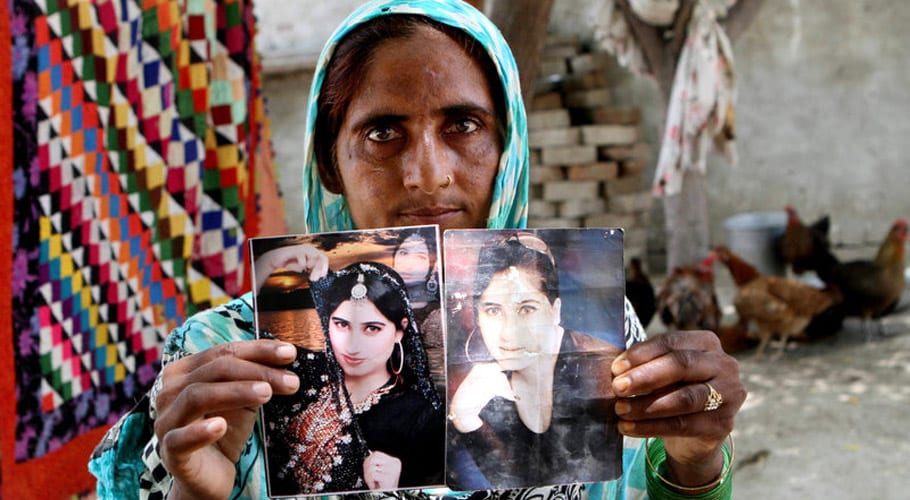
Fouzia Azeem known by her stage name Qandeel Baloch was a Pakistani model, actress, social media celebrity and activist.
Qandeel Baloch rose to prominence due to her videos on social networks discussing her daily routine, her rights as a Pakistani woman, and various controversial issues.
Baloch first received recognition from the media in 2013, when she auditioned for Pakistan Idol; her audition became famous and she became an Internet celebrity.
She was one of the top 10 most searched for persons on the internet in Pakistan and both celebrated and criticised for the content of her videos and posts.
Early life
Qandeel Baloch was born on 1st March 1990 in Dera Ghazi Khan area of Punjab. She came from an underprivileged family, the daughter of Anwar Bibi and Muhammad Azeem who scratched a living from local farming.
Growing up she was interested in her studies as well as acting and singing. Before her rise to fame, her first job was as a bus hostess.
In 2008, at age 17, Baloch was married to a local man named Aashiq Hussain, her mother’s cousin. She had a son with him.
Her husband beat and tortured her and later divorced her. Baloch claimed her husband had been abusive, and cried publicly about the pain of the marriage.
Career
Baloch’s fame was based on her social media posts pictures, videos and comments. Some international news media compared her to ‘Kim Kardashian’.
However, local commentators stated that she was more significant than Kardashian, as Baloch “went against the norms of society” and lived life on her own terms.
She started to appear on Pakistani talk shows regularly by 2014, either to perform songs or to discuss her rising social media popularity.
Meeting with Mufti Abdul Qawi
In June 2016, Baloch met senior cleric Mufti Abdul Qawi at a hotel to learn more about her faith; the interaction between them brought about mayhem on social media platforms, as their photos became popular online.
Security concerns
Following the June 2016 meeting with Qawi, Azeem held a press conference and reported that she received death threats both from him and from others, and demanded police protection from the state.
Death of the social media celebrity
On 15 July 2016, Qandeel Baloch was drugged and then asphyxiated by her brother Muhammad Waseem while she was asleep at her parents’ home in Multan.
Her death was reported by her father Azeem. It was first reported as a shooting, but an autopsy report confirmed that Baloch was murdered by asphyxiation while she was asleep, on the night of 15–16 July.
Marks on Baloch’s body revealed that her mouth and nose were pinned shut to asphyxiate her.
First Information Report
A First Information Report against her brother Waseem and another brother Aslam Shaheen, who allegedly persuaded Waseem to kill their sister, was registered.
Later, Waseem and other suspects were arrested. Waseem confessed to murdering his sister, saying “she [Qandeel Baloch] was bringing disrepute to our family’s honour”.
Court verdict
A model court in Multan on September 27, 2019, sentenced Qandeel Baloch’s brother Mohammad Waseem, the prime suspect in her sister’s murder case, to life imprisonment.
The rest of the suspects who were nominated in the case, including cleric Mufti Abdul Qavi, her other brother Aslam Shaheen, Haq Nawaz, Abdul Basit and Mohammad Zafar Hussain were acquitted by the court.
Reactions
Baloch’s murder was widely condemned by media celebrities and people around the globe, while many in Pakistan were more inclined to support her murder.
Several personalities, including British Prime Minister Theresa, also condemned the murder saying “there is absolutely no honour in so-called honour killings and they should be referred to as acts of terror.
The daughter of the Pakistani ex-Prime Minister Maryam Nawaz announced that the government had finalized the draft law against honour killings in the light of negotiations and the final draft will be presented to a committee of a joint session of parliament on 21 July for consideration and approval.
Anti-Honour Killing Laws
In fact, it was the social media celebrity’s high-profile murder that provided the momentum for the Anti-Honour Killing Laws (Criminal Laws Amendment) Act to finally be passed in October 2016, a few months after her death.
Unlike most cases of ‘honour’ killings, many of which go unreported, the circumstances surrounding Qandeel’s death were well documented and the intent behind her murder clear.
Baloch’s parents announce a pardon for sons
The parents of social media star Qandeel Baloch — who was murdered allegedly by her brothers had submitted an affidavit in a Multan court, saying they have forgiven the killers and the case against their sons should be thrown out.
However, the Anti-Honour Killing Laws (Criminal Amendment Bill) 2015 — which prevents killers from walking free after being pardoned by the victim’s family — was passed months after Baloch was murdered and, therefore, cannot be applied to her case.
Pakistan needs more effective laws against ‘honour’ killings
Pakistan needs true justice for Qandeel, and for the many more women whose lives are forever altered or cut short by crimes covered up by the unbearably toxic burden of ‘chadar aur chardiwari’.
Although the introduction of progressive laws in recent years is a positive step, they are still far from perfect, not to mention the fact that enacting legislation while ignoring issues within the mechanisms through which they are to be implemented betrays a lack of seriousness.
Unalloyed commitment to upholding women’s fundamental rights must permeate the entire edifice of the criminal justice system — and at every stage, from reporting to investigation to court procedure.
The criminal justice system of the country does not appear to guarantee the fundamental right to a fair trial and justice to every citizen.
The system is thus a classic example of a grave violation of the constitutionally guaranteed rights of every citizen because it fails to achieve its fundamental objective to protect the victims, punish the guilty and thus make the society safe for every citizen.
ADVERTISEMENT