










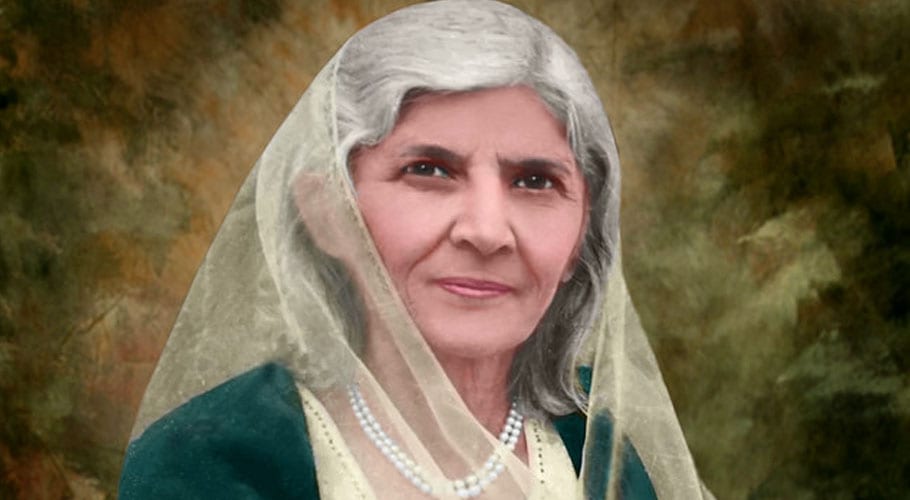
Fatima Jinnah, widely known as ‘Madar-e-Milat’ (Mother of the nation) was a passionate political worker, a women’s rights activist, and a qualified dental surgeon.
Fatima Jinnah was the youngest of eight brothers and sisters born to Jinnah’s father Poonja Jinnah. In this family of seven siblings, she was the closest one to Mohammad Ali Jinnah.
On her 53rd anniversary, let us take a look at her life, her active role in the independence movement with the Quaid-e-Azam, and other important issues.
Early Life and education
Fatima Jinnah was born on 31 July 1893 in Kathiawar, Gujarat, British India. In 1902, she was sent to the Bandara convent where she remained in the hostels as her parents had died.
In 1919, she enrolled in Dr. Ahmed’s Dental College at Calcutta. On graduating in 1923, she opened her own dental clinic in Bombay. By his support for his sister, Jinnah made a point that he was not averse to the idea of girls getting a higher education. He always wanted women to participate in political rallies.
Fatima Jinnah – Mother of the nation
When Jinnah returned to India from London and started organizing the Muslim League, Fatima’s companionship of her brother entered into a new phase.
She accompanied him everywhere and felt the necessity of bringing Muslim women into the political affairs of the Muslim nation. She attended various women’s organizations varying from Girl Guide movement to mass agitation. Mohatrama Fatima Jinnah became a member of the working committee of the Bombay Provincial Muslim League and worked there until 1947.
After the advent of Pakistan when the nation was faced with serious problems with the settlement of refugees from India, she set up various organizations to help them start a new life. Fatima visited various refugee camps along with her brother to talk to ladies of the camps and encourage them to fight the ordeals they were facing.
Fatima Jinnah as an activist
Fatima Jinnah is truly a role model for the women of Pakistan because she not only worked for creating awareness among women but also fought a hard battle alongside his brother to make the dream of making a new country Pakistan a reality.
She developed feelings of sympathy for others and tried to ameliorate their problems. As a keen observer, she took an interest in the status of women in British society. She concluded that education and social status had made the British women equal partners in the affairs of their state and society. In this respect, she promoted women’s education, health, political work, and social activities.
1965 elections
She returned to the forefront of political life in 1960 announced to participate in elections. Her opponent was Ayub Khan.
Fatima Jinnah train which was called Freedom Special train was 22 hours late because men at each station pulled the emergency brake and they begged her to speak to them.
Fatima Jinnah had a great advantage of being the sister of Quaid-e-Azam. The campaign of Fatima Jinnah generated the people of Pakistan’s feelings of hope.
Ayub Khan, on the other hand, was the sitting president and enjoyed the support of the armed forces. Ayub Khan had a great advantage over all the candidates. He utilized the state facilities as the head of the state and didn’t hesitate to legislate on electoral matters.
Moreover, there was the misuse of presidential powers and the Elections Commission was always anxious to please military dictator. Ayub Khan used basic democrats, radio, and newspapers for the character assassination of his opponents.
Elections were held on 2nd January 1965. Ayub Khan won with 63 percent of votes. Fatima trailed behind with only 36 percent of votes. She might have won if the elections had been direct.
However, she did not lose courage and in spite of old age and defeat in the elections kept herself on the move. She took on the entire Ayub regime and openly criticized the dictator. She was ridiculed by the Basic Democrats but she did not lose heart.
Death
A year later, she passed away at the age of 71 on July 9, 1967. The official cause of her death was a heart attack. However, still a number of politicians, and even Jinnah’s nephew Akber Pirbhai, insist that she was murdered.
She was 71 and is buried beside her brother’s grave in his impressive mausoleum in Karachi.
ADVERTISEMENT