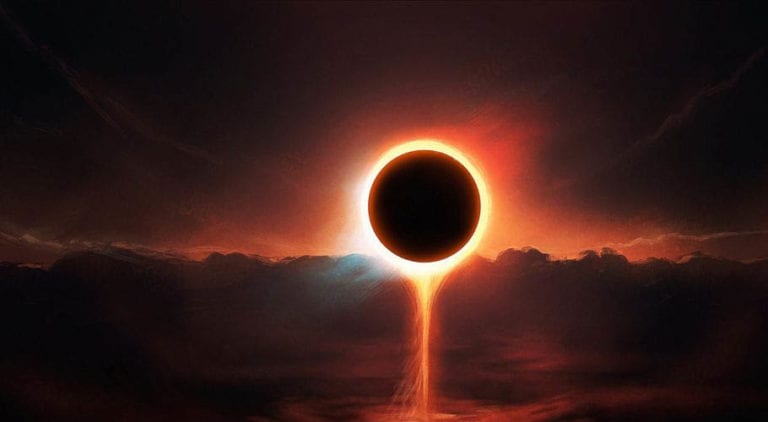
KARACHI: The annular solar eclipse, popularly known as the ‘ring of fire’ has descended upon parts of Pakistan on Sunday, June 21.
According to Pakistan Meteorological Department (PMD), the eclipse started at 8:46 AM and would end at 2:34 PM across the country, while it will reach its peak at 11:40 PM.
A solar eclipse happens when the moon passes directly between the Earth and the sun. An annular solar happens when the moon covers the Sun’s center, forming a ‘ring of fire’ or annulus on its outer edges.
Experts warn people not to look directly at the sun without any protective eye apparatus as it could damage eyesight and even lead to blindness. The radiation would be much more direct than it was during the last solar eclipse that occurred previously.
Apart from the southern parts of Pakistan, the specter would also be visible in several areas including the Central African Republic, Congo, Ethiopia, northern India, and China.
A partial eclipse can be observed in Karachi starting at 9:26 AM and ending at 12:46 PM and reaching its peak at 10:59 AM. The solar eclipse is expected in Sukkur starting at 9:33 AM, peaking at 11:07 AM and ending at 12:54 PM.
The rare and historic event is completely different from the total solar eclipse that took place in August 1999 due to the ‘albedo effect’.
It means that most of the radiation did not reach the ground and got deflected back into space because of cloudy skies previously.
But this time there are clear skies. Therefore, there will be a direct impact of the radiation on earth. There are several superstitions being associated with the celestial event. Some say it may bring about major changes in world politics with shifts in power.
Other beliefs include thoughts of fear. In ancient China, people used to counter the effects of a solar eclipse by getting together and screaming aloud. They believed that there was a big snake eating up the moon which needed to be stopped and scared away with the noise.
ADVERTISEMENT