










The United Nations had adopted June 19 every year as the International Day for the Elimination of Sexual Violence in Conflict in 2015. The key aim of this day is to raise awareness of the need to put an end to conflict-related sexual violence across the globe.
The day also honours all the victims and survivors of sexual violence around the world and pays tributes to the brave hearts who have devoted and lost their lives in raising voices for the eradication of such crimes.
Sexual violence haunts women in IOK
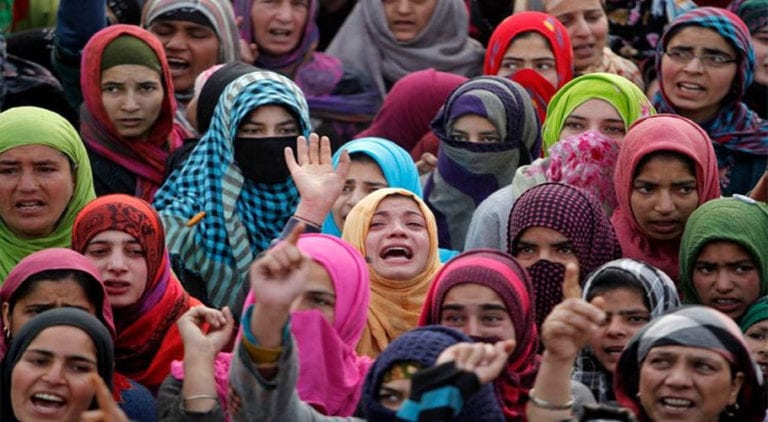
It’s a double-edged sword for women in Indian Occupied Kashmir (IOK) – to live in a conflict zone and also experience a constant threat of sexual violence.
As the world marks United Nation’s International Day for Elimination of Sexual Violence in Conflict today the women in Indian Occupied Kashmir continue to face the horrors of rape, sexual abuse and molestation at the hands of Indian security forces.
Over 11,000 women became victims of rape in IOK
In the past three decades, more than 11,000 women have been victims of rape or gang-rape at the hands of Indian occupation forces in occupied Jammu & Kashmir.
Recent rape cases in IOK
Even amid the COVID-19 lockdown, 16 rape cases and 64 incidents of molestations were reported from Jammu and Kashmir Territory in 33 days.
The Kashmir conflict has been characterized by large scale incidents of sexual violence by Indian security forces, who use rape as a method of retaliation against Kashmiri women.
Women in IOJ&K have frequently been targets of violence and aggression as a means to punishing their families and communities for standing up against illegal and forcible Indian occupation.
The abduction and molestation of young women during so-called “cordon-and-search operations” has been used as a punitive tool by Indian occupation forces to punish entire communities.
These repugnant acts of violence against women are enabled through a pervasive culture of impunity, reinforced by draconian laws such as the Armed Forces Special Powers Act (AFSPA) that shield the Indian security forces from prosecution from their crimes of sexual violence.
UN reports
Recent reports by the UN and other agencies indicate that Indian forces in Kashmir often target women to demoralize their people who are demanding an end to the Indian occupation. The reports point out that “the frequent rape of Kashmiri women by Indian state security forces routinely goes unpunished.”
The horrific mass rape of Kashmiri women in Kunan Poshpura villages of IOJ&K on 23 February 1991 is one of many pieces of evidence of systematic use of rape by Indian occupation forces to terrorize the entire population.
United Nations role
The United Nations, which was set up to resolve disputes and issues between the nations, has so far failed to stop the rape of women in occupied Kashmir.
According to UN Secretary-General Antonio Guterres, the world stands with the survivors of sexual violence and vows to listen to them and act on their experiences and decisions. However, these claims and promises are not to be implemented practically.
Attention need in the constant plight of Kashmiri women
On the International Day of Elimination of Sexual Violence in Conflict, the world needs to heed attention towards the constant plight of Kashmiri women. It is time to recognize their right to an environment free from sexual abuse, rape and torture.
The world must wake up to these war tactics in IOJ&K, in violation of International Humanitarian and Human Rights Law as well as applicable UN Security Council Resolutions.
ADVERTISEMENT