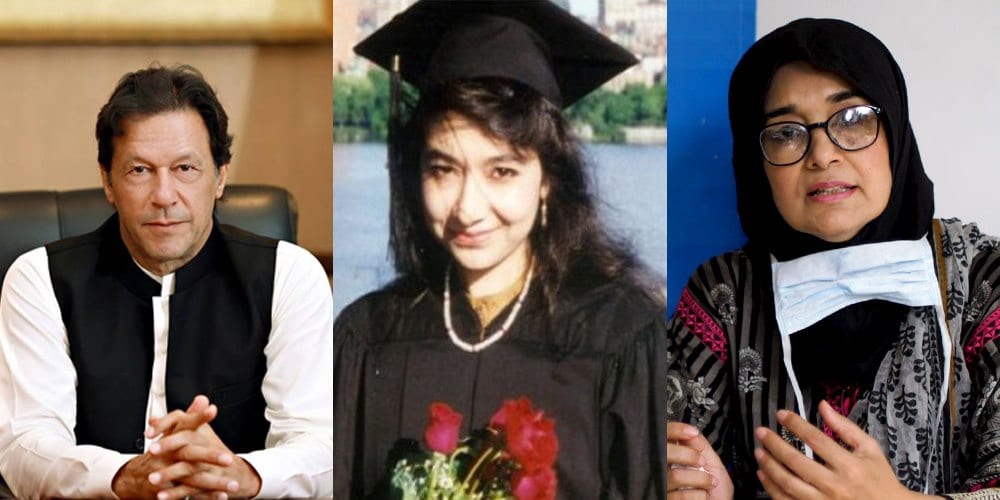
The mysterious silence of the incumbent government regarding the release of Dr. Aafia Siddiqui – jailed in the US for almost a decade – has raised many questions.
Current Prime Minister Imran Khan was the first to bring the case of Pakistan’s daughter, Aafia Siddiqui, to the forefront. However, no positive steps were taken by Imran Khan after becoming Prime Minister.
Let’s take an in-depth review of the matter of Aafia Siddiqui.
Who is Aafia Siddiqui?
Aafia Siddiqui –born on March 2, 1972, in Karachi – is a neuroscientist with degrees from MIT and Brandeis University. She came to the United States on a student visa in 1990 for undergraduate and graduate education and eventually settled in Massachusetts. In 1995, she agreed to a marriage arranged by her mother to Karachi-born anesthesiologist Amjad Mohammed Khan whom she had never seen. The marriage ceremony was conducted over the telephone.
Her husband statement
After 9/11 Aafia insisted on returning to Pakistan, telling her husband that the US government was forcibly converting Muslim children to Christianity. Later, she pressed him to go on “jihad” to Afghanistan, where she had arranged for them to work in a hospital in Zabul province. Khan refused, sparking a vicious row. “She went hysterical, beating her hands on my chest, asking for a divorce,” he recalled.
In August 2002, Khan alleged that she was abusive and manipulative throughout their seven years of marriage; he suspected she was involved in extremist activities. Khan went to Siddiqui’s parents’ home, announced his intention to divorce her. The couple’s divorce was finalised on 21 October 2002.
Remarriage
In February 2003, Siddiqui married Ammar al-Baluchi, an accused al-Qaeda member and a nephew of al-Qaeda leader Khalid Sheikh Mohammed. While her family denies she married al-Baluchi, Pakistani and US intelligence sources, a psychologist for the defense during her 2009 trial, and Khalid Sheikh Mohammed’s family all confirm that the marriage took place.
Disappearance
Shortly after returning to Pakistan, Siddiqui disappeared while en route to Islamabad with her three children – her family members believe she was abducted by the Pakistani intelligence agencies.
Little is known about what happened to her until she surfaced five years later in Ghazni, Afghanistan when Afghan police arrested her on suspicions of being a suicide bomber.
As FBI agents and US military personnel arrived to interrogate her, they said she gained control of a rifle belonging to one of the army officers. In the struggle that ensued, the service member fired on Siddiqui, hitting her at least once in the torso.
For the next few days, Siddiqui underwent surgery, after which she was transferred to a prison in the United States – where she has been ever since. While in custody in Ghazni, police allegedly claimed that they found documents and notes for making bombs along with containers of sodium cyanide in her possession.
Aafia Siddiqui’s court appearance
At the time of the appearance in the court, Dr. Aafia Siddiqui looked very weak and frail and she denied all the allegations. Dr. Aafia’s sister claimed that the first judge rejected Aafia’s case and ordered to send her back to Afghanistan. However, top US officials removed the judge and presented the case to another judge who sentenced Aafia Siddiqui to 86 years in prison on September 23, 2010.
PM Imran claims regarding Aafia’s case
Prime Minister Imran Khan included the issue of Dr Aafia Siddiqui in his election manifesto for the 2018 general elections. After becoming the Prime Minister, he hinted to bring Dr. Aafia to Pakistan in place of Dr. Shakeel Afridi, who helped find Osama bin Laden, the leader of Al Qaeda. However, after his visit to the United States, Prime Minister Imran Khan has remained silent on the issue.
ADVERTISEMENT