










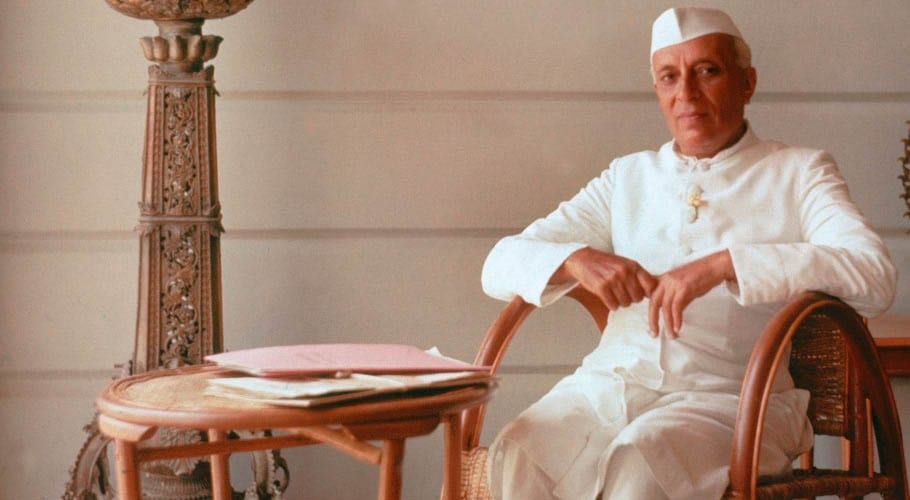
Jawaharlal Nehru was an influential leader in the Indian independence movement, an Indian nationalist leader and statesman, who became the first prime minister of independent India in 1947.
Although faced with the challenge of uniting a vast population diverse in culture, language and religion, he successfully established various economic, social and educational reforms.
Let’s look at a brief review of the life of Jawaharlal Nehru.
Early Life
Nehru was born in Allahabad, India on November 19, 1889. Nehru was born to a family of Kashmiri Brahmans, noted for their administrative aptitude and scholarship. His father – Motilal Nehru – was a renowned lawyer and one of Mahatma Gandhi’s notable lieutenants.
A series of English governesses and tutors educated Nehru at home until he was 16. Jawaharlal also had a venerable Indian tutor who taught him Hindi and Sanskrit. Nehru subsequently attended Harrow in England and, later, Trinity College, Cambridge.
He later studied law at the Inner Temple in London before returning home to India in 1912 and practicing law for several years.
Four years after his return to India, in March 1916, Nehru married 17-year-old Kamala Kaul. The following year, their only child, Indira Priyadarshini (later named Indra Gandhi), was born.
Politics
Nehru first had tried to settle down as a lawyer, however, he had only a desultory interest in his profession and did not relish either the practice of law or the company of lawyers.
In April 1919, British troops opened fire on thousands of unarmed civilians who had been protesting on a recently passed legislation. The incident is known as the Massacre of Amritsar, in which 379 Indians were killed and more than a thousand others were wounded. The incident changed the course of Nehru’s life.
Nehru joined the Indian National Congress, one of India’s two major political parties. Nehru was deeply influenced by party leader Gandhi.
During the Non-Cooperation Movement (1920-22), Nehru was imprisoned for the first time for activities against the British government.
In 1929, Jawaharlal was elected president of the Indian National Congress—his first leadership role in politics—whereby he promoted the goal of complete independence from Britain as opposed to dominion status.
Independence and Prime Minister
On August 15, 1947, India finally gained its independence and Nehru became the nation’s first prime minister. The mass displacement that followed partition into the separate nations of Pakistan and India, along with disputes over control of Kashmir, resulted in the loss of property and lives for several hundred thousand Muslims and Hindus.
The importance of Nehru can be distilled to the following points: he imparted modern values and thought, stressed secularism, insisted upon the basic unity of India, carried India into the modern age of scientific innovation and technological progress.
Nehru was especially proud to reform the antiquated Hindu civil code. Nehru also changed Hindu law to criminalize caste discrimination. Nehru’s administration established many Indian institutions of higher learning, including the All India Institute of Medical Sciences, the Indian Institutes of Technology, and the National Institutes of Technology.
The conflict, known as the Sino-Indian War, had a deleterious effect on Nehru’s health, resulting in a severe stroke in January of 1964 and his death a few months later on May 27.
ADVERTISEMENT