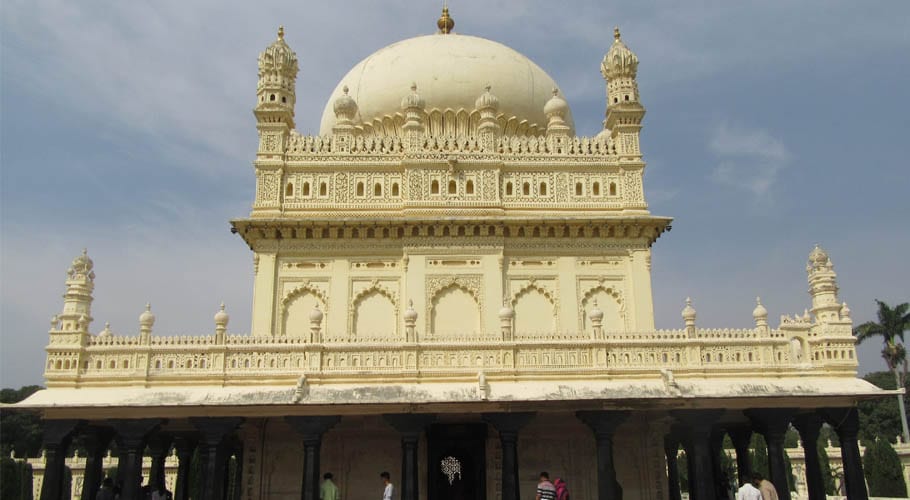
Today marks the 221st anniversary of Tipu Sultan’s martyrdom. He is remembered by many in India and Pakistan as a heroic freedom fighter and warrior-king.
Tipu was vigorous, forceful, brave, warlike and cruel; a devout Muslim ruling a mainly Hindu population.
One of the famous quotes of Tipu Sultan is: “It is far better to live like a lion for a day than to live like a jackal for a hundred years.”
Let’s take an in-depth review of Tipu Sultan’s life
Early life
Tipu Sultan was born on November 20, 1750, to military officer Hyder Ali of the Kingdom of Mysore. His parents named him Fath Ali but also called him Tipu Sultan. He was born in Devanahali, Bangalore.
His father Hyder Ali was an able soldier and won such a complete victory against an invading force of Marathas in 1758. While his father rose to fame, young Tipu Sultan was receiving education from the finest tutors available.
He studied such subjects as riding, swordsmanship, shooting, Koranic studies, Islamic jurisprudence, and languages such as Urdu, Persian, and Arabic. Tipu Sultan also studied military strategy and tactics under French officers from an early age.
In 1766 – when Tipu Sultan was just 15 years old – he got the chance to apply his military training in battle for the first time. The youngster took charge of a force of 2,000-3,000 and cleverly managed to capture the Malabar chief’s family.
After this achievement at such a young age, his father gave him command of 500 cavalries and assigned him to rule five districts within Mysore. It was only a start for a younger fighter.
Tipu’s fondness and First Anglo-Mysore War
Tipu Sultan had a special reverence for tigers. He kept six in his fortress-city of Seringapatam (now Sriringapatna), where his throne was shaped and striped like a tiger.
His elite troops wore tiger badges, the hilt of his sword was in the form of a snarling tiger, and his favourite toy was a mechanical tiger straddling a British officer. He was determined to build a rich and powerful state.
In 1767, the British formed a coalition with the Nizam and the Marathas, and together they attacked Mysore. Hyder Ali managed to make a separate peace with the Marathas, and then in June he sent his 17-year-old son Tipu Sultan to negotiate with the Nizam. In just one week, Tipu charmed the ruler of the Nizam into switching sides.
Hyder Ali and Tipu Sultan then went on a tear up the coast, capturing forts and British-held cities. The Mysoreans were threatening to dislodge the British from their key east coast port of Madras when the British sued for peace in March 1769.
Death of Hyder Ali
While the Second Anglo-Mysore War was still raging, the 60-year-old Hyder Ali developed a serious carbuncle. His condition deteriorated throughout the fall and early winter of 1782, and he died on December 7. After that Tipu Sultan came to the throne at the age of 32.
The British hoped that this transition of power would be less than peaceful and attacked the area. However, Tipu’s smooth transition and immediate acceptance by the army thwarted them.
Death of Tipu Sultan
The British were never able to defeat Tipu as long as they fought without intrigues, conspiracies, and deceitfulness.
In May 1799, the British and their allies surrounded Seringapatam, the capital of Mysore. Tipu Sultan had just 30,000 defenders matched against 50,000 attackers. On May 4, the British broke through the city walls. Tipu Sultan rushed to the breach and was killed defending his city.
The news of Tipu’s defeat and death caused excitement in England and his treasure-hoard provided ample prize money for the British senior officers. The throne was bestowed on an infant member of the previous Hindu dynasty. The tigers were shot.
ADVERTISEMENT