











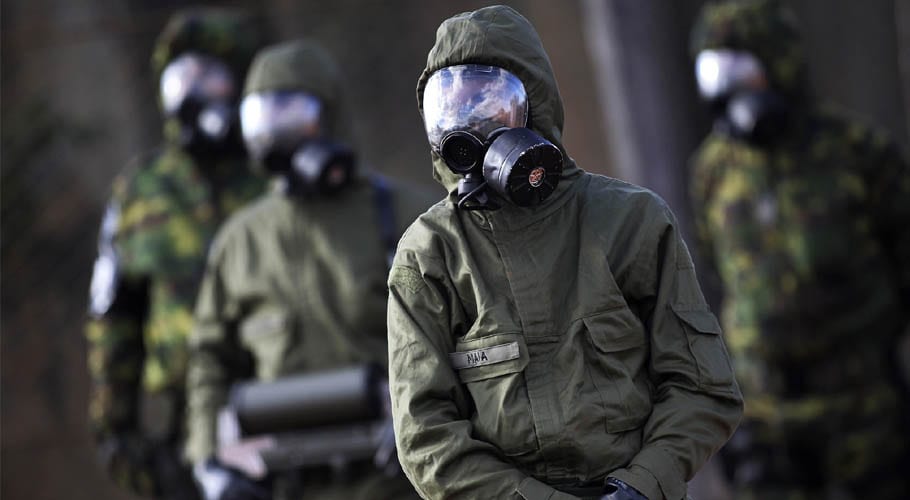
The modern notion of chemical warfare emerged in the 19th century after the development of modern chemistry and associated industries. Use of chemical weapons is more dangerous than you may know and cause irreparable harm to humanity.
On 16th March 1988, the Halabja chemical attack – also known as Halabja Massacre –occurred in which thousands of civilians mostly children and women were killed by chemical weapons.
Iraqi warplanes and artillery pounded the Kurdish town of Halabja in northern Iraq with mustard gas and the deadly nerve agent sarin.
The responsibility was placed on the cousin of the Iraqi president Saddam Hussein. Ali Hassan al-Mujahid, who was allegedly responsible for the incident, was dubbed as General Chemical Ali due to the use of chemical weapons.
Let’s take an in-depth review of Chemical warfare, its history and the consequences faced by humanity.
What is Chemical Warfare?
As the name suggests, chemical warfare is a war between two or more countries during which chemical weapons are used. This kind of warfare involves using toxic properties of chemical substances as weapons. Chemical warfare is distinct from the use of nuclear weapons and conventional warfare because the destructive effects of chemical weapons are not primarily due to any explosive force.
Chemical weapons and warfare agents
Chemical substances are used in these types of weapons. These weapons do not just kill a human being but paralyze them.
The chemicals used in these weapons are known as chemical warfare agents. During the 20th and 21st century, about 70 different types of chemicals have been used in chemical warfare. These agents can be in different forms, solid, liquid and gas.
According to International Chemical Weapons Convention, There are reportedly fifty types of chemical warfare agents. These can be categorized into four different categories:
1- Nerve Agents: These weapons can affect our nerves and make us unconscious. It can also cause muscle paralysis, as well as seizures and loss of body control.
2- Blood Agents: These agents work by preventing a person’s blood and tissue cells from accepting oxygen intake and can lead to organ failure.
3- Chocking Agents: These chemicals are absorbed through the lungs and will result in a build-up of fluid that will potentially lead to choking.
4- Blister Agents: The chemicals that are blister agents will burn a person’s mucous membranes, skin, and eyes, and cause blistering.
Short History
The use of chemical weapons has a long history, but if we talk about the modern notion the first chemical weapons were used in the First World War (1914 to 1918). Poisonous gases were used as chemical weapons through which it is estimated that 90,000 people lost their lives.
Chemical weapons have been used numerous times since then. The most usage of chemical weapons was occurred in the Iraq-Iraq war from 1980 to 1988.
Later, the use of chemical weapons was also seen in the Syrian Civil War. Similarly, chemical weapons were also used during the Cold War between Russia and the United States from 1945 to 1991.
Irreparable damages and Convention
Chemical warfare has caused billions of life and has badly affected humanity. The effects of chemical weapons on humans can be not only extensive but quite hazardous. The effect of certain chemical weapons could bring lifelong damage that would remain after the conflict ends.
In this regard, a convention was signed in Paris on 13 January 1993 to outlaws the production, stockpiling and use of chemical weapons and their precursors.
ADVERTISEMENT