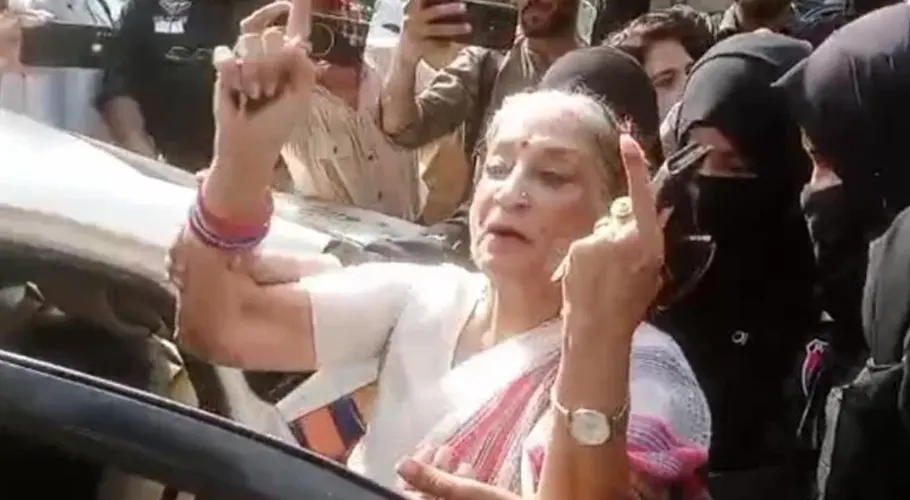











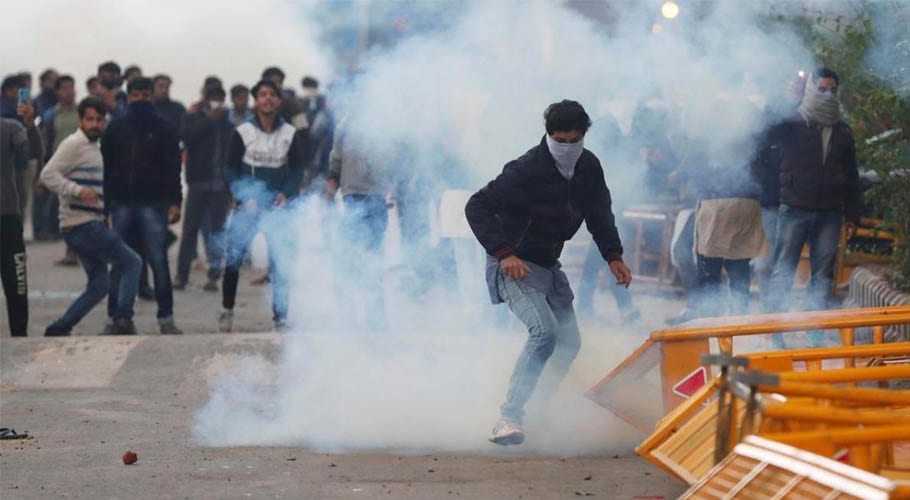
The Muslim riots in India’s capital, New Delhi, are undoubtedly one of the worst incidents of recent times. The violence has spilled over the streets against the contentious citizenship law and the fascist Hindutva policies. Muslims have been worst victims and faced the biggest burnt of mob violence.
The death toll has risen to 46 as Muslim neighborhoods were attacked and the shops, mosques, schools and vehicles were set on fire.
However, history proves that this is not something new that is happening with Muslims in India. If we look towards the history of the atrocities against Muslims several cases can be witnessed, after which came to a two-nation theory that still holds true today.
Let’s take an in-depth review of the riots in New Delhi. How it all started and what is the citizenship law?
The violence
The unrest was triggered after the ruling party in India – Bharatiya Janata Party (BJP) – leader Kapil Mishra threatened the protestors (Muslims) against continuing the weeks-long peaceful sit-ins against the new citizenship law.
This was the spark that eventually ticked off the mob and the Hindu-nationalist mobs attacked the sit-ins in New Delhi.
After that northeast Delhi’s Karawal Nagar, Seelampur, Maujpur, Bhajanpura, Vijay Park, Jafrabad, Chandbagh, Mustafabad and Yamuna Vihar witnessed pitched battles between Hindus and Muslims.
The Hindu-nationalist mobs vandalizing Muslims properties and mosques, while carrying saffron flags and chanting ‘Jai Shri Ram’. In these riots, several mosques, temples, schools, homes, vehicles were torched by the rioters.
The violence has so far claimed lives of 46 people (mostly Muslims) and more than 200 people injured. Many of the deaths claimed to have died of bullet wounds.
What is CAA law?
The Citizenship (Amendment) Act 2019 was passed by Indian Parliament on 11th December 2019. It amended the Citizenship Act of 1955 by providing a path for non-Muslims from neighbouring Muslim-majority nations to gain citizenship.
The Act grant citizenship to “persecuted” Hindus, Parsis, Sikhs, Buddhists, Jains and Christians who arrived in India before December 31, 2014, from Bangladesh, Pakistan or Afghanistan. Muslims from those countries were not given such eligibility.
The amendment was heavily criticized by opponents as discriminating against Muslims and has deepened concerns that Modi’s administration is undermining India’s secular traditions and imposing its Hindu nationalist agenda on the nation.
Modi’s government has also revoked the partial autonomy of Kashmir, India’s only Muslim-majority state.
Two Nation Theory
National leader Sir Syed Ahmed Khan did much for the Muslim reforms and disagreed with some cultural and religious traditions with the British and Hindus which led to severe criticism.
Sir Syed Ahmad Khan had long ago realized that Hindus and Muslims could not live together. In addition, major leaders of the history of the subcontinent came to understand the view and Quaid-e-Azam Muhammad Ali Jinnah adopted that view in the name of two-nation theory.
The Two Nation Theory states that Muslims and Hindu are two different nations in every definition that Muslims have their own customs, traditions, religion, and Hindus have their own.
Explaining the two-nation view, Quaid-e-Azam said that Muslims who stand with India today and do not want to go to Pakistan will spend the rest of their lives proving themselves an Indian citizen.
Truth of Two Nation Theory
The two-nation ideology of Pakistan’s founder is stepping up today. Sadly, the truth of the doctrine is proving through blood flowing.
The truth of the two-nation view is that Indian Hindus have not been able to understand Muslims as their own till now. Muslims could not adopt Hindus even by violating Islamic principles. Muslims and Hindus were also separate identities yesterday and still are separate today.
Despite being called a secular country, India has become a bastion of prejudice and extremism.
ADVERTISEMENT