The United States and Afghan Taliban coined history yesterday in Doha, capital of Qatar. The US and Taliban signed a landmark peace agreement bringing an end to nearly two decades old war in Afghanistan.
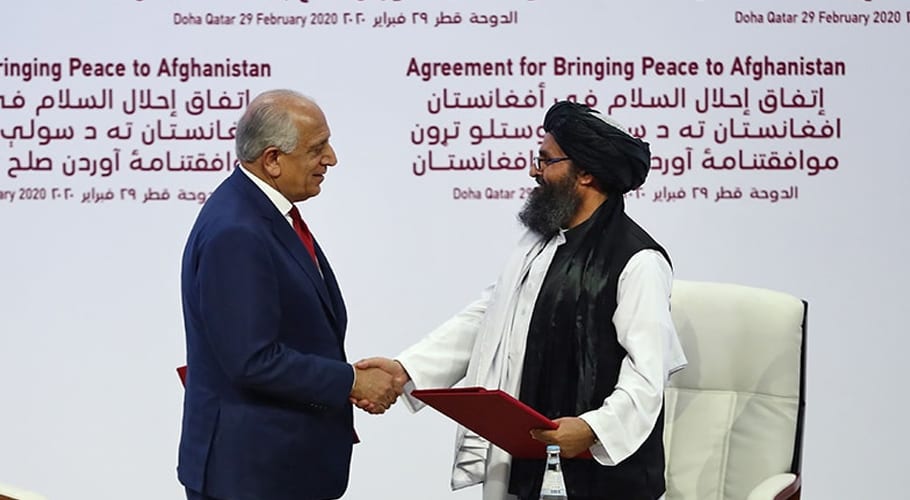
After months of speculation about when the deal would be signed, and what the contents would be, culminated in a plush conference room in the Qatari capital Doha, when Taliban political chief Mullah Abdul Ghani Baradar signed the accord along with US special envoy Zalmay Khalilzad.
Both of the personalities then shook hands, as people in the room shouted: “Allahu Akbar” (God is greatest).
The signing ceremony was witnessed by Qatari Emir, US Secretary of State Mike Pompeo, Foreign Minister Shah Mehmood Qureshi and his counterparts from seven countries and representatives from fifty countries.
The agreement creates a path for the US to gradually pull out of its longest war in Afghanistan, many expect talks to come between the Afghan sides may be much more complicated.
Let’s take an in-depth review of how it all started and what’s next?
US-Taliban War
Following the attack in the US on September 11 in 2001, which President George Bush blamed Osama Bin Laden who claimed to be living or hiding in Afghanistan and had already been wanted since 1998, President Bush demanded that the Taliban, who were ruling the country, hand over bin Laden.
The Taliban declined to extradite him unless they were provided clear evidence of his involvement in the attacks, which the US refused to provide. Then on 7 October 2001, US launched Operation Enduring Freedom, also known as war in Afghanistan, and US invaded the country on the same date.
More than 1,000 US soldiers were on the ground at the time, with numbers growing and the numbers were increasing until the war stopped.
About 157,000 people have been killed in the Afghanistan war since 2001. More than 43,000 of those killed have been civilians.
The Peace Deal
The peace deal between the US and Taliban was signed in a hotel in Doha, Qatar. Taliban political chief Mullah Abdul Ghani Baradar signed the accord along with US special envoy Zalmay Khalilzad.
According to the agreement, the US will release 5,000 Afghan Taliban. On the other hand, the Taliban will be forced to release 1,000 soldiers, along with Afghan soldiers.
The peace deal further said that the United States will withdraw its forces from Afghanistan within 14 months.
A joint declaration has also been issued in this regard. According to the joint declaration, Afghan soil cannot be used to attack the US and allies.
The joint declaration stated there will be Intra-Afghan talks to bring political stability in the country. Intra-Afghan talks will begin on March 10.
The US will not use force against the integrity of Afghanistan, the joint declaration added.
Afghan Taliban and US reaction
Leader of Taliban delegation Mullah Abdul Ghani Baradar expressed full commitment to the agreement by his side. He said as a political force we want to maintain positive relations with all neighbors, regional countries and the international community who played a key role in this agreement.
He thanked Pakistan for its assistance and support in making the deal successful. He also appreciated the role of China, Russia, Iran, Uzbekistan, Norway, Indonesia and other countries in supporting the peace process.
US Secretary of State Mike Pompeo in his address said that the agreement is a true test of the effort to give peace a chance. He said it will ensure that Afghanistan never becomes a base of terrorists again.
Appreciating the US Representative for Afghanistan Reconciliation Zalmay Khalilzad, he said he played a critical role in making the negotiations successful. He urged Taliban to sit with Afghan government to determine the course for future of Afghanistan.
What’s Next?
In fact, neighboring country of Pakistan, Afghanistan, has created many difficulties for the country. This is because of the influence of the US and India. The establishment of a stable Afghan government is essential for peace in Pakistan. However, the days ahead will show whether these cordialities are genuine, or if the once-bitter foes return to face each other on the battlefield.
ADVERTISEMENT