









An elderly woman dressed in a maroon ghagra choli stood before me. She was lean, her hair grey, and face full of fatigue.
“I am unable to conceive, am I normal? My in-laws think I am barren, what should I tell them?”
The question baffled me.
“Eat eggs, drink milk and consume lentils, ingest as much protein as you can,” the doctor told her after a quick examination.
“You are completely normal, just try eating what I asked you to.”
As soon as she left, I turned to the doctor still perplexed, “She is simply a victim of malnutrition”, the doctor answered.
Unfortunately, the 20-year-old, whom I thought was an elderly woman, turned out to be a case of severe malnutrition which is a highly common occurrence in Thar.
Tharparkar, widely known as Thar, is one of the largest districts of the Sindh province. It is infamous for its waterborne diseases, inadequate health facilities, famine and lack of basic infrastructure.
At four in the morning, when I arrived at Mitthi, stars yet dimly lit the barren region. There was something unpleasantly unique about this dessert; there was little difference between the young and the old.
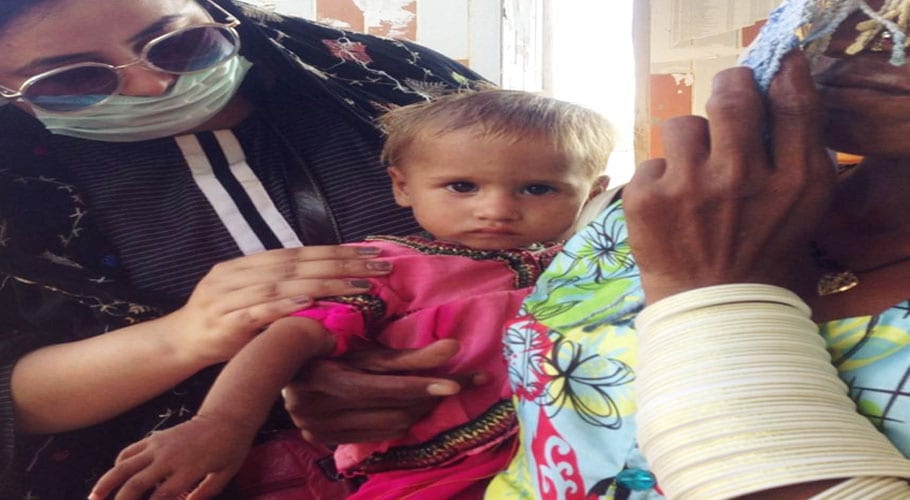
Waiting for her number outside the camp sitting on the ground, I saw a teenage mother with two children; one in her lap and another one standing. I asked her what had bought her here? Her half-face peeped out from underneath a shocking pink veil but she didn’t reply. I asked her again. She simply pointed a finger at her one-year-old son whose left leg was covered with a severe skin infection.

Dr. Ashok explained the cause of the infection to me, “The children here are not being washed with clean water after they pass feces or urine. They continue to eat and play covered in filth.”
Thar is a district with the highest percentage of households without any toilet facilities in Sindh.
“It is not the parent’s fault either. They do not have proper water to drink how will they manage to get it for other purposes?” Dr. Ashok clarifies.
Despite the fact that Asia’s largest Solar Plant has been installed in Thar, access to clean drinking water remains a problem. Merely 47 percent of the population consumes clean drinking water.
As per the Thardeep Rural Development Programme, 60 percent of households wait more than an hour for their turn to fetch drinking water via wells and 30 percent of households spend Rs. 30 for two buckets of water.
Thar is the only district in Sindh which does not have freshwater resources, the only source being the wells dug into the ground. However, this water is, in most parts, blackish and bad for the health. The lack of fresh-water does not allow farming.
The people of Thar are dying a slow death; they yearn for food and water. The provisional government has funds; there is no denying this fact. As per the World Food Programme 2019 report, Pakistan was provided US$362,000 along with 4,727 mt of food assistance. But where did the money go?
According to Pakistan’s Multidimensional Poverty Index report by UNDP, 87 percent of the population in Thar still lives under poverty. Pakistan’s highest infant mortality rate is found in the sandy region. Due to a lack of basic necessities, up to 900 children lost their lives in the district in 2019 alone.
Tharis are forced to sell off their animals to feed their children or else migrate to other regions. There are many villages that have become vacant due to severe poverty and lack of basic necessities. Suicide has become the other alternative.
Tharparkar has witnessed a new but quite disturbing trend over the past few years. People committed suicide due to a lack of facilities. More than 75 people took their lives in Tharparkar district whereas 55 committed suicides in Umerkot district till November 2019, 198 people in 2018, and 95 reportedly in 2017.
The provincial government and health authorities despite the worsening situation in the region have turned a deaf ear to the issue faced by the people of Tharparkar.
Plans are made for the betterment of Thar but unfortunately, these policies, and programs are only to paperwork. No practical measures to save this struggling population have been taken.
ADVERTISEMENT