










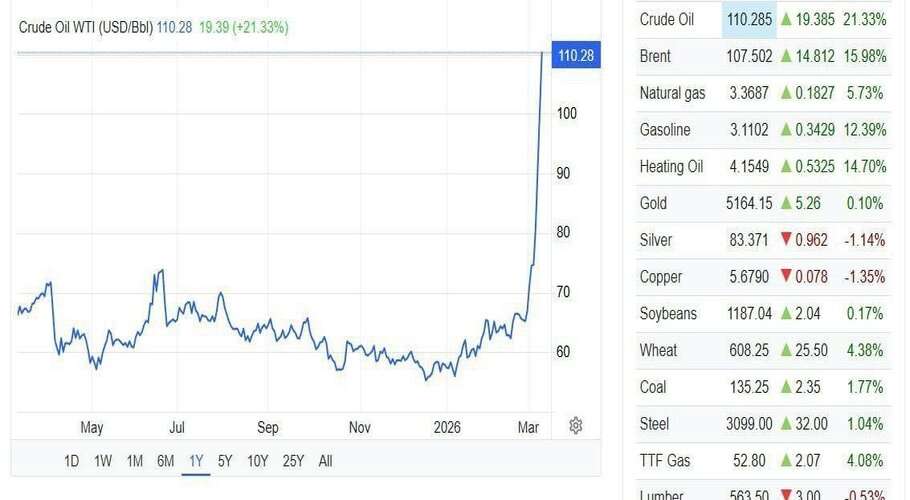
Crude oil prices crossed $110 per barrel on Sunday evening (Monday in Asia) after major Middle Eastern producers cut output, as the critical Strait of Hormuz remains closed due to the ongoing conflict involving Iran.
West Texas Intermediate jumped 26.5%, or $24, to $114.9 per barrel. The global benchmark Brent advanced 23%, or $21.56, to $114.25. U.S. crude oil surged about 35% last week, marking its biggest gain in futures trading history, dating back to 1983. The last time oil prices topped $100 per barrel was after Russia invaded Ukraine in 2022.
This spike followed Kuwait’s announcement of precautionary cuts to its oil production and refinery output on Saturday, citing “Iranian threats against the safe passage of ships through the Strait of Hormuz.” The state-owned Kuwait Petroleum Corporation did not specify the size of these cuts.
Furthermore, output in Iraq, the second-largest OPEC producer, has effectively collapsed. Production from its three main southern oilfields has dropped 70% to 1.3 million barrels per day, according to three industry officials speaking to Western media outlets on Sunday. Prior to the conflict involving Iran, these fields produced 4.3 million bpd.
In addition, the United Arab Emirates, the third-largest OPEC producer, stated that it is “carefully managing offshore production levels to address storage requirements.” The Abu Dhabi National Oil Company (ADNOC) noted that its onshore operations continue to function normally.
In response to the surge in oil prices, President Donald Trump posted on Truth Social, asserting that a gain in “short-term oil prices” was a “very small price to pay” for addressing Iran’s nuclear threat.
“Only fools would think differently!” Trump added.