









Countries around the world including Pakistan are celebrating International Women’s Day today (Sunday 8th March) to raise awareness against gender bias, women empowerment and take action for equality.
This year’s theme for Women’s Day was, “I am Generation Equality: Realizing Women’s Rights.”
The day not only recognizes the achievements made by women but also raises awareness of the obstacles that still stand in their way.
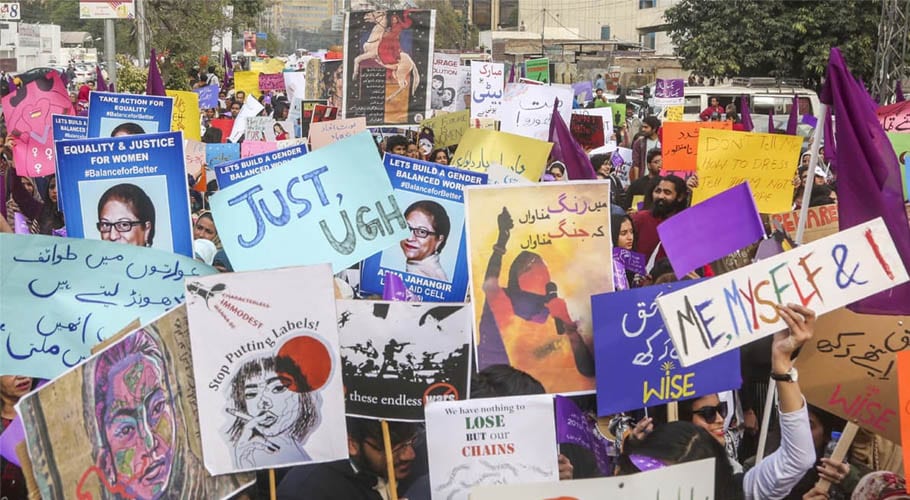
In this regard, Aurat March was held in many cities of Pakistan. The women of the country took to the streets and reclaim public spaces and raise their voices against injustice, misogyny and patriarchy.
The participants were holding interesting banners and different slogans were raised in the Aurat March against the patriarchal system of Pakistan.
In the lead up to the March, the country had remained largely divided over whether or not the event should be held.
While some of the people linked the participants of these Aurat March with feminism and called them feminists.
Well, then the point is what is Feminism? Let’s take an in-depth review of this school of thought.
The Feminism
Feminism is not a disease but a theory. The term feminism can be used to describe a political, cultural or economic movement that seeks equal rights and legal protection for women. The Theory at its core is about the equality of men and women.
Feminism involves political and sociological theories and philosophies concerned with issues of gender difference, as well as a movement that advocates gender equality for women and campaigns for women’s rights and interests.
Modern Western feminist history is conventionally split into three periods or ‘waves’. First Waves (19th century), Second Wave (1960-1980), the current Third waves (1990- continue)
Islam and Feminism
With regard to feminism, it is also important to understand that feminism is not an Islamic idea and is also not the kind of equation that Islam spoke about 1400 years ago. Rather, it is a modern way of thinking that is not Islamic.
If you will remember that last year when the feminists spoke of women’s rights in the name of Aurat march, so the majority of the so-called Islamic people opposed it. Why did this happen? Is Islam Against Feminism?
The fact is that Islam speaks of the equal rights of men and women, however, Islam has imposed certain responsibilities on women which are not obligatory on men.
For example, the Quran contains clear verses that Women should have a full veil arranged before leaving the house.
Islam gives men the edge over women in some aspects, and there is a clear difference between Islam and feminism in terms of inheritance rights.
That could be a long debate. Feminists have a different approach to religion.
Pros and Cons of Feminism
If we talk about the positive aspect of feminism, it talks about equality – Women are equal to men, women are confident and courageous enough to admit it, keeps women from being exploited.
Feminism also gives confidence in the women to stand up for what you believe in. It is also a two-way school though which also invites men to participate and raised the voice for the women and should support the initiative, which states that men are also feminists too.
And on the other side, there are some cons of feminism that tend to oppose this school of thought.
Feminism generates the idea that there are no differences between men and women. But it is false. There are differences, and the people should not make either gender superior or inferior to the other.
Women demand equality, yet wish to use the “you don’t do that to a woman.” Argument.
There should be no extremism in any way. The real problem for women is not to get opportunities for equality, divorced marriage, inheritance, work, marriage, sex abuse, unwanted marriage, the pursuit of education.
Even today, girls’ education is not given special importance in Pakistan. These are the issues that need to be addressed.
But ridiculous slogans and absurd demands are not the way to raise the voice and don’t gave linked with the earliest feminism.
ADVERTISEMENT