








Politics is a pre-requisite of every democratic system in the world and political psychology and behaviours reflect the whole image of every country.
Different political stunts are always used to gain a certain aim against opponents or exposing their weaknesses. The political blame game and political agenda-setting are always prevalent in countries but civilised states avoid using scandals to fight their opponents or resolving their issues.
To keep morality in check during the political blame game is indispensable to sustain a good image of the country and its people.
The current political scenario in Pakistan has become the worst in its nature. This is against the norms, values, traditions, and principles of a civilized nation.
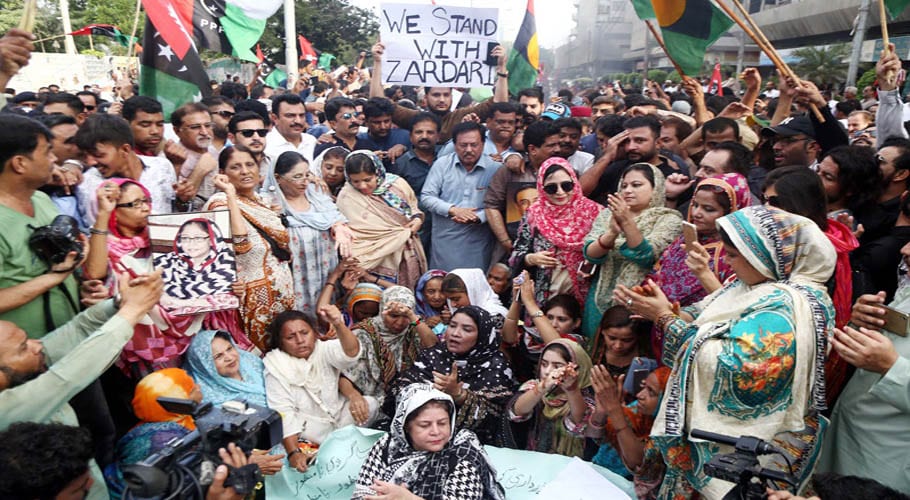
The blame game between the Pakistan Tehreek-i-Insaf (PTI) and Pakistan Peoples Party (PPP), the ruling parties in Punjab and Sindh, over the handling of the civic issues, including coronavirus situation, inflation, and load shedding, is ongoing with both parties accusing each other of playing politics over the issues and doing nothing on the ground.
Flour, sugar and other necessities are slowly disappearing from the reach of the masses across the country, while load-shedding continues unabated in the metropolis despite assurances from the federal government.
It is interesting to know who is a ‘blame maker’ and who is the ‘blame taker’ in Pakistan at the moment.
Power outages
Despite the pandemic and lockdown, the worst prolonged and unannounced power outages by K-Electric are still happening across Sindh.
K-Electric has started testing the already depleting patience of the city’s people — especially virus patients observing self-isolation and those living in hotspot areas under smart lockdown — due to intermittent power disconnections.
Loadshedding in different areas of the metropolis has increased to over nine hours a day, while some areas are experiencing as much as 13 hours of loadshedding a day.
The people are compelled to go out of homes due to power suspension that might increase the number of coronavirus patients.
It is the responsibility of the Sindh government to oblige K-Electric to avoid prolonged and unannounced power outages. Sindh Chief Minister Murad Ali Shah should take concrete steps despite the blame game.
The Sindh government and the federal government are busy scoring political points by holding responsible for each other to load shedding; both the governments should take solid steps to address the issue.
Prices of daily necessities skyrocketed
Even during the second year of PTI government, flour, sugar, milk, ghee, tea leaves and other daily necessities have seen a huge increase in the prices, which has made the life of the common man extremely difficult.
The federal government announces relief, while the mafia does not allow prices to fall and all the items are stockpiled. The political figures behind them are also being exposed over time. However, no action has been taken against them.
People across Pakistan, including Sindh, are currently facing a shortage of wheat and flour crisis.
The tragic situation is that looking at the current scenario, there may be a shortage of 1.9 million metric tons of wheat expected during the current financial year.
To prevent this, it is necessary to control the storm of wheat hoarding, profiteering, and artificial inflation by taking concrete measures.
Prices of petroleum products
An unusual situation had been observed leading to a shortage of petrol and diesel at fuel stations across the country adding to the miseries of people.
The government had reduced the price of petrol but people could not endure crushing fuel shortages.
The federal and provincial governments had also failed to implement the reduction in petroleum prices across the country in which all the governments, as well as concerned agencies, are equally responsible.
It needs to be seen whether actions will be taken against those creating oil shortages or will the government succumb to the oil cartel.
The role of media
The role of media is very important in political blame game. Several issues that were prioritized were strongly associated with selective media coverage.
Media coverage is used in politics because it is suitable for political elites. It is relevant to further their goals. The information encapsulated through media forms a useful political resource.
The media must help both state and society overcome the challenges confronting them with as little pain as possible.
Pakistan’s major problems
Pakistan has faced major challenges in its socioeconomic situation over the past seventy years. However, not all problems have been overcome.
The key problems of today include water scarcity; the lack of sustainable development projects; an increasingly unemployed youth population, lack of focusing on human development projects, continuous reduction in the foreign exchange reserves, and the increase in non-developmental expenditures.
The increase in public debt, the unequal distribution of wealth, rising deprivation in Baluchistan, Sindh, GB and Southern Punjab, unpleasant situation in the region, especially relations with eastern and western neighbours.
The poor condition of small and medium enterprises (SMEs) and failure to effectively implement the local bodies system considered the basic need of for democracy should be addressed on priority.
Pakistan must remain a constitutional democracy with the highest protection afforded to the fundamental rights of its people. The blame game is a waste of time.
In politics, even if the problem is someone else’s fault, the blame game is a waste of time, effort, and energy that takes the attention away from the solution. It creates restlessness and creates a trust deficit.
The prevailing political situation will only create conflict and will become a huge hindrance in the way of progress. Rather than humiliating each other, political parties should really be working together to fix the issues and only by mutual cooperation can we lead our country in harmony.
The federal and provincial governments and the national institutions within their available resources should make flat-out efforts to counter the issues as soon as possible.
ADVERTISEMENT