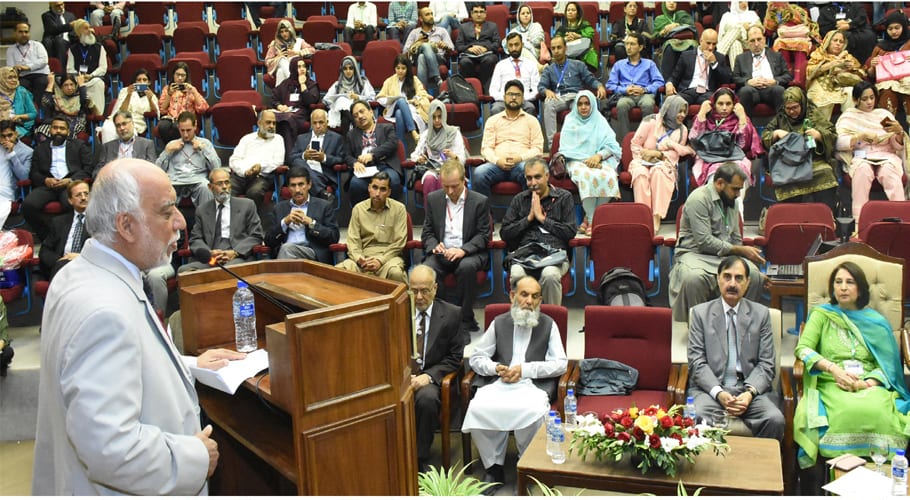
KARACHI: The author of the Flora of Pakistan, Professor Dr Muhammad Qaiser has announced that the project ‘Flora of Pakistan’ has been completed and it is a matter of huge pleasure not only for Karachi University but for the whole nation.
He termed that it was without any doubt a landmark success and certainly it was a great task to complete. He said that it is a book dealing with the plants of a defined geographical area.
The major aim of a Flora is to provide means of recognition of the plants growing in the area. He said Pakistan has the boundless biological wealth to Pakistan, adding that the land has a very rich Flora, to utilize this plant wealth properly and scientifically the plants should be correctly identified.
He was addressing the inaugural ceremony of the four-day long International Symposium on Plantlife of South Asia, on the successful completion of Flora of Pakistan, at the Jinnah Auditorium’s Dr A Q Khan Institute of Biotechnology and Genetic Engineering, KU.
The Center of Plant Conservation and the Department of Botany Karachi University has jointly organized the event, while local and international scholars from eight different countries are participating in the symposium.
Professor Dr Muhammad Qaiser mentioned that if the plants are not correctly identified their utility is limited. Flora provides baseline information. This information can be utilized for scientific study, in industries such as the pharmaceutical industry, agriculture environment management, forestry, and others.
He shared that Professor Syed Iratafaq Ali from Karachi and Professor Nasir from Rawalpindi started the work on the plants in the country. Moreover, he said that Godon College had a very rich heritage of Dr Stewart in the form of 55, 000 plant specimens which he collected for over 50 years all over Pakistan (then India).
He added that in terms of issues related to conservation and environmental threats Pakistan is facing many challenges. It has a population of more than 199 million, the fifth-largest in the world. One of the most important issues involves water pollution, shortage of clean water, deforestation, soil erosion, desertification and climate change resulting in variation in rainfall, an increase in temperature, melting of glaciers.
He advised that to address these problems Pakistan needs good information about its natural resources. Flora is based on all available plant collections and at least gives an idea of the previous vegetation and climate and also gives information on the most current taxonomy of these plants.
It is the first step to understand and managing conserving our fast-depleting biodiversity of the area. The former KU VC Professor Dr Muhammad Qaiser said that only the last three fascicles are to be uploaded.
This electronically available Flora of Pakistan is, in fact, the database of all the flowing plants of Pakistan can be used with the data on soil types and other parameters such as what intact habitat should have the highest priority for conservation, what type of plants should be used to control soil erosion, reforestation or other conservation issues.
Meanwhile, another former Vice-Chancellor of the University of Karachi Professor Dr Syed Irtafaq Ali while sharing his views, he had expressed that the completion of Flora of Pakistan Project is an extraordinary work done by our specialists.
He mentioned that there is a long list of those who have contributed a lot in this regard and Dr R.R. Stewart, Professor E. Nasir, Abdul Ghafoor, Ian C. Hedge, B.L. Burtt, Jennifer almond are few to be named.
He said that directors, curators, and librarians of Kew Herbarium, British Museum, Royal Botanic Gardens Edinburgh, New York Botanic Garden, Natural History Museum, Vienna had helped in providing herbarium and library facilities and several contributors have very graciously revised various families for the Flora.
He also acknowledged that the Andrew W. Mellon Foundation, USAPak – US Science and Technology cooperation program through Higher Education Commission and Pakistan Academy of Sciences have given funds for the printing of some parts of Flora.
ADVERTISEMENT