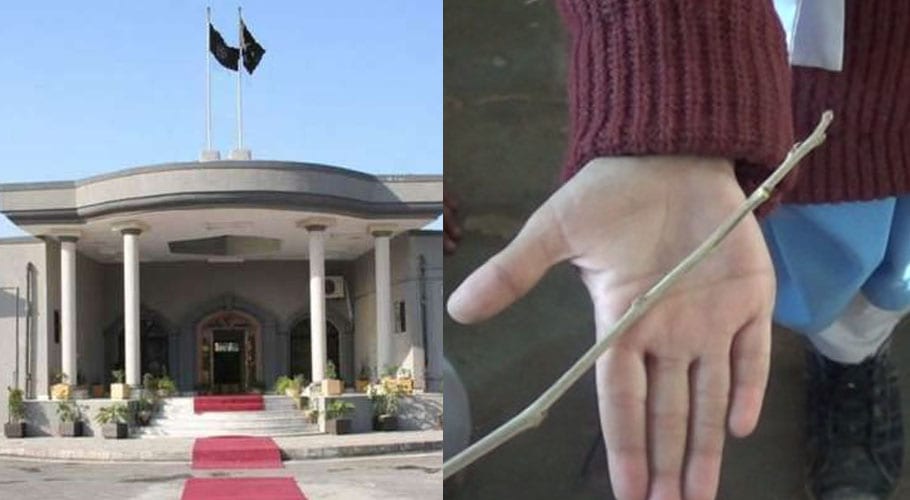
ISLAMABAD: Islamabad High Court (IHC) on Thursday banned all forms of corporal punishment in schools under the federal government.
The high court heard the case on the petition of singer Shehzad Roy, who has been involved in activism regarding education reforms for years. Roy asked the court to abolish Section 89 of the Pakistan Penal Code (PPC), which allows parents, guardians and teachers to use corporal punishment in “good faith”.
IHC Chief Justice Athar Minallah, who was presiding over the case, remarked that Parliament had also been working on a bill on corporal punishment. The judge said that the Article 14 of the constitution grants children the right to dignity and respect.
The counsel for Rory informed the court that a child had passed away in Lahore due to corporal punishment. He said that the parliament can continue the work on the passing of the bill but the punishment should be banned.
He pleaded the court that students were being subjected to brutal torture by teachers. and such behaviour would affect the mental growth of students.
Justice Minallah subsequently suspended Section 89 of the PPC in the federal capital territory until the case’s conclusion. He ordered the government to submit its reply to the petition by 5th March.
Read more: IHC disbars Kashif Chaudhry over fake degree case
Earlier, a petition filed by prominent singer Shehzad Roy stated that his plea was against student torture in educational institutes.
In Pakistan, punishing mostly seems to be an appropriate technique to control behaviour of students. The United Nations Convention on the Right of the Child prohibits physical punishment by teachers in schools. The UN has termed it an ineffective method of discipline as it brings negative rather than positive impacts on the students.
Section 89 of the Pakistan Penal Code states an “act done In good faith for benefit of child or insane person, by or by consent of guardian,” can be allowed with certain exceptions.
ADVERTISEMENT