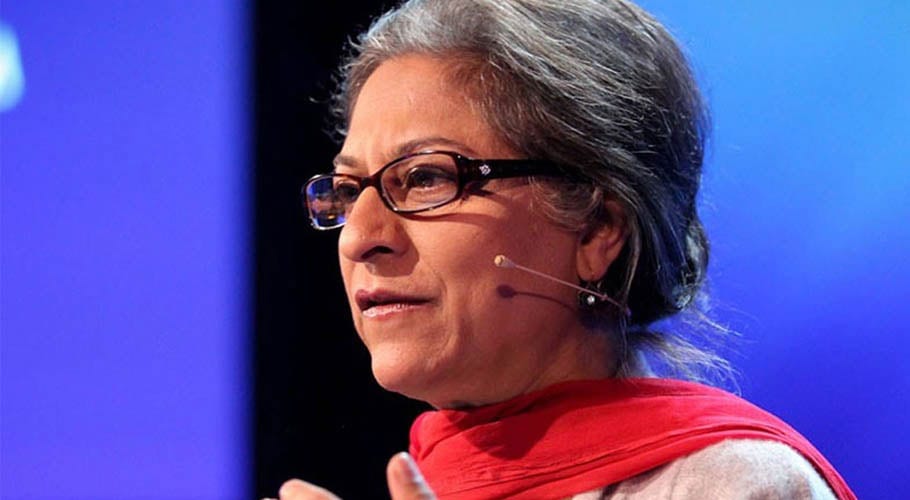
Death anniversary of eminent Democratic Lawyer and the human rights elite, Asma Jahangir is being observed today across Pakistan.
Known for her outspoken nature and unrelenting pursuit for human rights and remained undaunted in the face of extreme pressure and opposition, Asma Jahangir will be remembered as a champion of the disenfranchised and for her services towards building a democratic and more inclusive Pakistan.
Today, on the second anniversary of Asma Jahangir, we will try to understand what his political and social services were and why she was considered a controversial figure.
Asma Jahangir and her journey
The renowned Social Activist was born on 27 January 1952 in Lahore. She received his early education from a school named, the Convent of Jesus and Mary in Lahore.
She received a bachelors’ degree from Kinnaird College and an LLB degree from Punjab University. She became a lawyer in 1978. Asma Jahangir was called to Lahore High Court in 1980 and to Supreme Court in 1982. She later went on to become the first woman to serve as the president of the Supreme Court Bar Association.
She was a pro-democratic lawyer and activist and was imprisoned in 1983 for participating in the Movement for the Restoration of Democracy against Military Dictator Ziaul-Haq. Later in 1986, she moved to Geneva and became the Vice-Chair of the Defence for the Children International.
Asma Jahangir Famous cases
The fearless lawyer fought many cases and gave strength to many people to raised voice against injustice.
Asma’s father case: Asma’s father, politician Malik Ghulam Jilani openly opposed two dictators, Ayub Khan and Yahya Khan, and pays the price by being imprisoned in 1971. He was a true inspiration for Asma Jahangir. Her father taught her to stand for one’s rights even against the most powerful forces. At that time Asma was 21-year-old, she didn’t falter despite her young age, but fought and won her case to release her father from the dictator’s prison – this case is famously known as Asma Jahangir case.
Minority Rights Case: Jahangir was also known for her dispassionate support for the rights of religious minorities. In 1993, an 11-year-old Christian boy, Salamat Masih, and his uncles, Manzoor Masih and Rehmat Masih were accused of writing blasphemous words on the wall of a mosque in a small town near Lahore. Asma Jahangir successfully represented the Christians and in 1995, after a hard battle, in and out of the courtroom, the Lahore High Court acquitted Salamat Masih and Rehmat Masih on February 23, 1995.
Services and Honours
She received several awards which include Hilal-i-Imtiaz in 2010 and a Sitara-i-Imtiaz. She was also awarded a Unesco/Bilbao Prize for the Promotion of a Culture of Human Rights and an Officier de la Légion d’honneur by France.
She also received an award for the 2014 Right Livelihood and the 2010 Freedom Award from the International Rescue Committee.
She co-founded the Human Rights Commission of Pakistan and the Women’s Active Forum (WAF).
She authored two books titled, ‘Divine Sanction? The Hudood Ordinance’ and ‘Children for a lesser God: Child Prisoners of Pakistan’.
Criticism on Asma Jahangir
The democratic lawyer was one of the most vocal critics of the Pakistani military regime. Her advocacy against the Pakistani government landed her multiple times and even led to death threats.
She was always criticized for being against Military leadership and dictatorship in the country.
Actually Asma Jahangir rose voiced against all the Military rulers, which includes General Yayha Khan, General Ziaul Haq and in 2007, she opposed General Pervaiz Musharraf. She was also under house arrest in Musharraf’s tenure.
Death
On 11 February 2018, the fearless lawyer, Asma Jahangir suffered a cardiac arrest and was subsequently shifted to hospital where she breathed her last. She died at the age of 66.
ADVERTISEMENT