










KABUL / ISLAMABAD: China appears to have intensified its diplomatic mediation between Afghanistan and Pakistan, a move which follows a series of unprecedented military exchanges that have threatened to destabilize the region and derail critical economic corridors.
The Afghan Interior Ministry confirmed that Interior Minister Sirajuddin Haqqani met with Chinese Ambassador Zhao Xing in Kabul earlier this week. The discussions focused heavily on China’s expanding role in advancing solutions to regional challenges, specifically the friction points between the two neighbors.
Ambassador Zhao reportedly emphasized that regional stability is a prerequisite for continued Chinese investment, while Minister Haqqani reiterated the de facto government’s commitment to security, despite the recent kinetic friction with Islamabad.
The “Urumqi Process”: A New Diplomatic Track
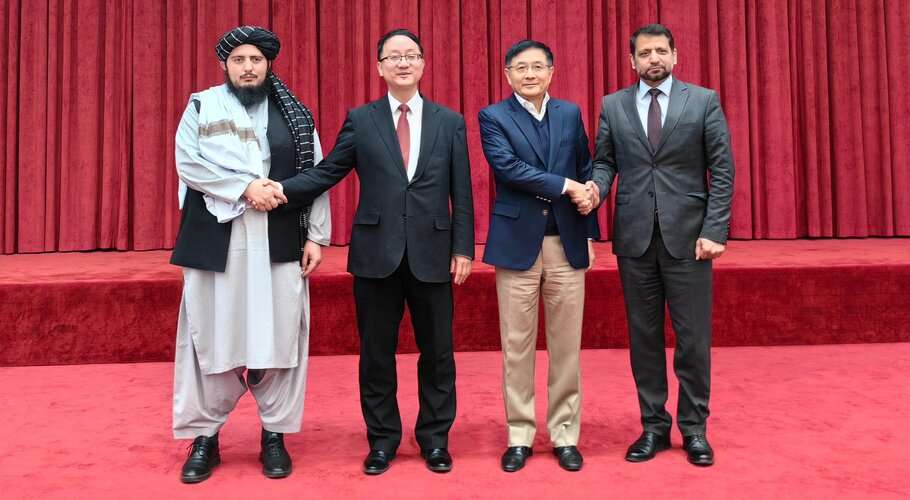
A significant breakthrough occurred earlier this month in Urumqi, China, where Beijing hosted a week-long series of informal talks between senior officials from Kabul and Islamabad.
– Format: The meetings involved cross-departmental delegations covering foreign affairs, defense, and security.
– Outcome: Both sides agreed to explore a “comprehensive solution” to their differences, identifying terrorism and border management as core concerns.
– The “Process”: Officials in Islamabad have expressed optimism that the Urumqi talks are not a one-off event but the start of a formal “Urumqi Process.”
“Maintaining good-neighborly relations is crucial for the well-being of both peoples. Dialogue is the only realistic approach to resolving these complex disputes,” stated a spokesperson for the Chinese Foreign Ministry following the talks.
Context: From Skirmishes to “Open War”
Diplomats say the urgency of China’s mediation stems from a volatile six-month period of hostilities. Tensions reached a breaking point in February 2026, when a series of cross-border attacks led Pakistan to declare what officials termed an “open war,” launching Operation Ghazab lil Haq.
The conflict, which saw the first-ever Pakistani airstrikes on urban centers like Kabul and Kandahar, was triggered by escalating attacks from the Tehreek-e-Taliban Pakistan (TTP). Islamabad accuses the Afghan Taliban of providing a safe haven for the group—a charge Kabul continues to deny.
| Period | Event | Impact |
| Oct 2025 | Initial Pakistani airstrikes in Kabul | Tenuous ceasefire brokered by Qatar. |
| Feb 2026 | Large-scale cross-border offensive | Hundreds of casualties; suspension of trade. |
| April 2026 | Urumqi Talks | Commitment to de-escalation and “comprehensive solutions.” |
Economic Stakes and Regional Connectivity
For Beijing, the normalization of relations is not merely a diplomatic preference but an economic necessity. The instability threatens the China-Pakistan Economic Corridor (CPEC) and broader trans-regional connectivity projects that aim to link Central Asia to the Arabian Sea via Afghanistan.
The “Urumqi Process” represents China’s most assertive effort to date to act as a regional power-broker, filling a vacuum left by Western withdrawal and aiming to secure a peaceful environment for its Belt and Road Initiative (BRI). While a fragile quiet has returned to the border following the talks, the long-term success of this mediation hinges on whether Islamabad and Kabul can reach a definitive agreement on cross-border militancy.