










TOKYO: Japan’s meteorological agency issued a tsunami warning on Monday after a powerful magnitude 7.4 earthquake struck off the country’s northeastern coast, prompting authorities to order immediate evacuations of coastal communities in the region.
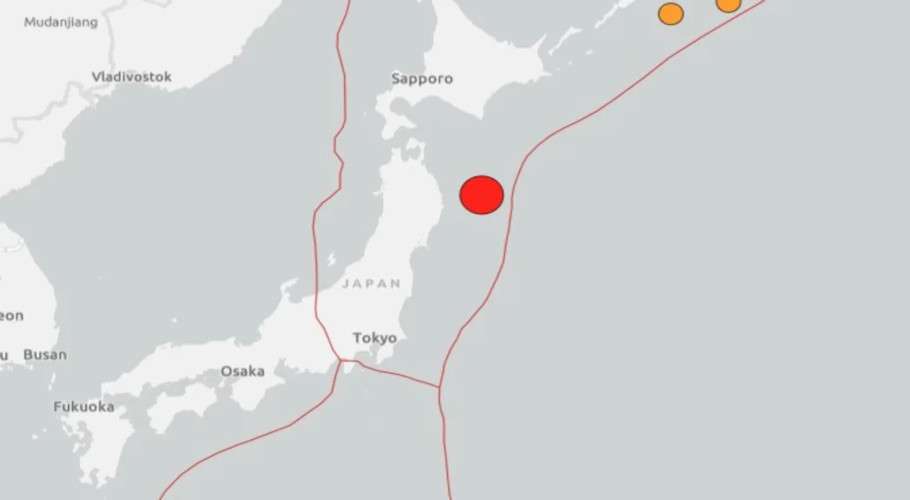
The quake hit at 4:53 p.m. local time (0753 GMT), with its epicenter located in the Pacific Ocean approximately 100 kilometers east-northeast of Miyako, in the Sanriku Coast area of the Tohoku region. The Japan Meteorological Agency (JMA) recorded a shallow focal depth of between 10 and 35 kilometers, a factor that can amplify surface shaking and tsunami risk.
Seismic intensity reached upper 5 on Japan’s seven-point scale in some areas. The JMA warned that tsunami waves of up to three meters (approximately 10 feet) could strike parts of Iwate Prefecture, as well as sections of Hokkaido and Aomori prefectures.
“Residents in coastal areas must evacuate to higher ground immediately,” officials said in an emergency broadcast. Authorities cautioned that waves could arrive repeatedly and warned against returning to low-lying areas until the all-clear is given.
Initial observations recorded small tsunami waves of between 20 and 70 centimeters at several ports along the affected coastline. No major damage or casualties had been reported as of early Monday evening, though the situation remained fluid and emergency services were on high alert.
The JMA and local disaster management officials said they were monitoring the situation closely. There was no tsunami threat issued for the U.S. West Coast, Canada, Alaska, or other distant Pacific regions, and no Pacific-wide alert was triggered.
Monday’s earthquake struck a region with painful historical resonance. The Tohoku coastline was devastated in March 2011 by a magnitude 9.0 earthquake and the tsunami it generated, which killed approximately 20,000 people and triggered the Fukushima Daiichi nuclear disaster — the worst nuclear accident since Chernobyl.
It may be added here that Japan is among the world’s most seismically active nations, sitting at the convergence of several major tectonic plates. Authorities have invested heavily in early-warning systems and sea walls since 2011, though experts have long cautioned that no infrastructure can fully eliminate the risk posed by major offshore quakes.
Earlier this year, a series of smaller earthquakes ranging from magnitude 5.0 to 6.2 struck areas including Tokyo and western Japan, none of which triggered tsunami warnings.
NO THREAT TO PACIFIC REGIONS
The Pacific Tsunami Warning Center (PTWC) and the U.S. National Tsunami Warning Center issued only informational statements for the U.S. West Coast, Alaska, British Columbia, Hawaii, and Guam — explicitly stating that no tsunami warning, advisory, watch, or threat is in effect for any U.S. or Canadian coastal areas.
The earthquake, while strong enough to generate local tsunamis near Japan, was not large enough — and the fault movement was not of the type — to send destructive waves across the Pacific to distant shores.
Only Japan has active tsunami alerts:
– Tsunami Warning (waves up to ~3 meters possible):
Iwate Prefecture (some areas reported waves already arriving or expected soon)
Parts of Aomori Prefecture (Pacific coast)
– Tsunami Advisory (waves up to ~1 meter):
Central and eastern Hokkaido (Pacific coast)
Other parts of Aomori Prefecture
– Tsunami Forecast (minor sea level changes):
Broader areas including Miyagi, Fukushima, Chiba, Izu Islands, Ogasawara Islands, and some southern coasts — small fluctuations possible, but no major threat.
No international tsunami warnings have been issued for any other country, including Russia, Pacific island nations, the Philippines, Indonesia, or other distant regions.