







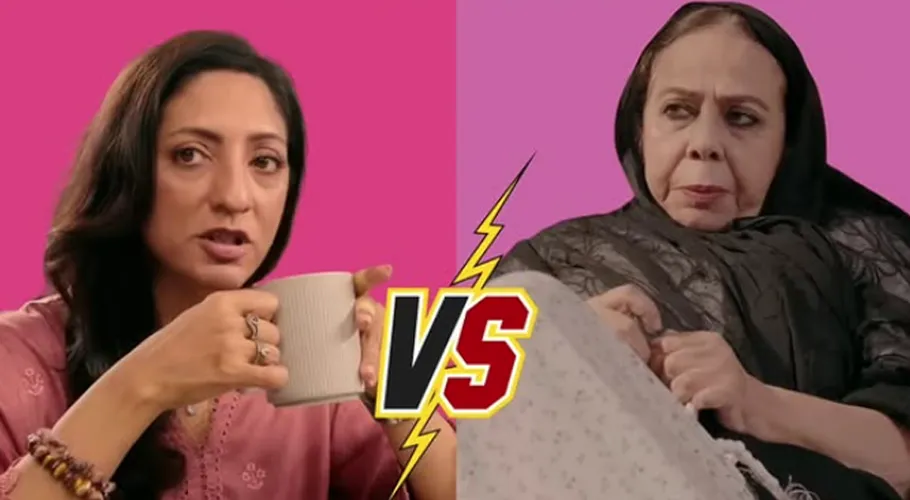
The latest episodes of the popular drama Jama Taqseem have confirmed a major shift in Pakistani television, replacing the singular ‘saas-bahu’ struggle with an even more explosive conflict: the war between two sets of parents.
The long-standing drama trope of a lone bride battling her mother-in-law (Qais’s mother) has now broadened into a fierce, multi-generational ideological showdown between Laila’s mother and Qais’s mother, and audiences are hailing Laila’s mother as the hero.
This recent storyline development, where both families end up living under the same roof for a period, perfectly encapsulates how the traditional joint family system is crumbling under the weight of modern expectations.
Tradition vs. Autonomy
The conflict is no longer just about household chores; it’s a direct battle between two distinct worldviews, played out dramatically over the dining table.
Qais’s mother represents the entrenched, conservative mindset of the joint family. Her demands are absolute: Laila must prioritize her in-laws, serve the family, abandon her career, and completely cut ties with her natal family.
Her comments are rooted in patriarchal pride, exemplified by her smug insistence that parents without sons must simply “Sabr karein” (have patience) when Laila’s mother questions who will care for daughters’ parents.
Laila’s mother is the voice of the modern, educated woman and a fierce advocate for her daughter’s rights. She confronts Qais’s parents head-on, refusing to tolerate their snide remarks and demanding respect for Laila’s education, career, and, most importantly, her right to look after her own parents.
View this post on Instagram
This powerful stance has resonated deeply with viewers, who praise her for normalizing the defense of a married daughter.
View this post on Instagram
In a highly praised scene, Laila’s mother, Zubia, challenges Qais’s family’s double standards, arguing that if a man’s parents are his responsibility, then a girl’s parents are equally hers.
This confrontation has become a rallying cry against the patriarchal notion that a woman is an exclusive commodity of her husband’s family.
This new dynamic has also completely redefined the husband’s role. Qais (Talha Chahour) is now stuck between two warring households, struggling to appease his traditional parents while managing his wife’s autonomous spirit and her supportive family.
His passive, often disrespectful, behavior towards his in-laws, like silently wishing for them to leave, has drawn significant criticism from viewers, who are labeling him a “walking red flag.”
View this post on Instagram
The drama highlights how the weight of a dysfunctional family dynamic is placed squarely on the newlywed couple, especially the man, who is expected to navigate the demands of both his birth family and his wife’s family without compromising his “honor” or his wife’s happiness.
A New Era of Family Drama
Jama Taqseem is succeeding precisely because it acknowledges that family toxicity is not limited to one gender or one house. By pitting mother against mother, it exposes the hypocrisy and double standards that permeate traditional structures, effectively rendering the old, simplistic ‘saas-bahu’ trope obsolete.
View this post on Instagram