











When supersonic aircraft break the sound barrier, they produce a powerful noise known as a “sonic boom.” The intensity of this boom can be so strong that it may shatter window glass, which is why supersonic flights are generally banned over populated areas.
Back in the 1970s, when Concorde and other supersonic jets began commercial operations, most countries restricted flights over land to prevent noise pollution in residential zones.
As a result, Concorde primarily flew over oceans—such as the Atlantic and Indian Oceans.
But now, that scenario is set to change.
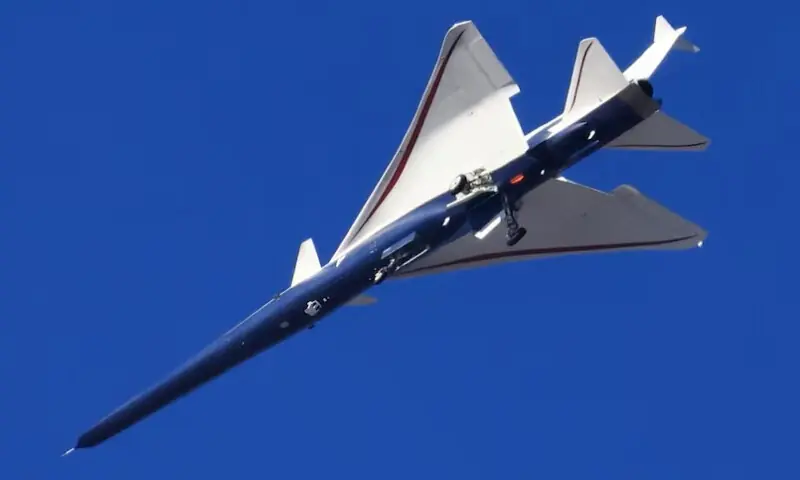
According to Reuters, a sleek, specially designed aircraft built by Lockheed Martin for NASA has taken off from the company’s Skunk Works facility in Palmdale, California, about an hour after sunrise. The jet then successfully landed near NASA’s Armstrong Flight Research Center at Edwards Air Force Base after a one-hour flight.
The aircraft, known as X-59, is designed to minimize the loud sonic boom typically associated with supersonic flight. Instead, when it breaks the sound barrier, it is expected to produce only a soft “sonic thump”, comparable to the sound of a car door closing.
This low-noise technology aims to remove the biggest barrier to commercial supersonic travel—public complaints about noise—so that future high-speed passenger flights over land could once again become viable.
Lockheed Martin stated that the technology could pave the way for the return of fast, quiet air travel in the coming decades.
NASA has paid Lockheed over $518 million since 2018 for the design, construction, and testing of the X-59, which measures just under 100 feet long. During its maiden flight, the jet flew at subsonic speeds, reaching 230 miles per hour at an altitude of 12,000 feet.
Around 200 aerospace employees and their families watched the flight from a safe distance.
The X-59, a unique experimental aircraft, is capable of reaching speeds of 925 miles per hour and flying at 55,000 feet—nearly twice as high and twice as fast as conventional passenger jets.
NASA says the data collected from these test flights will help set new noise standards for future supersonic travel, potentially allowing supersonic passenger flights over land for the first time in decades.