







The Indian occupied Kashmir (IoK) has been under lockdown for 165 days now. Due to the strict curfew imposed, Kashmiris are continually facing oppression and cruelty.
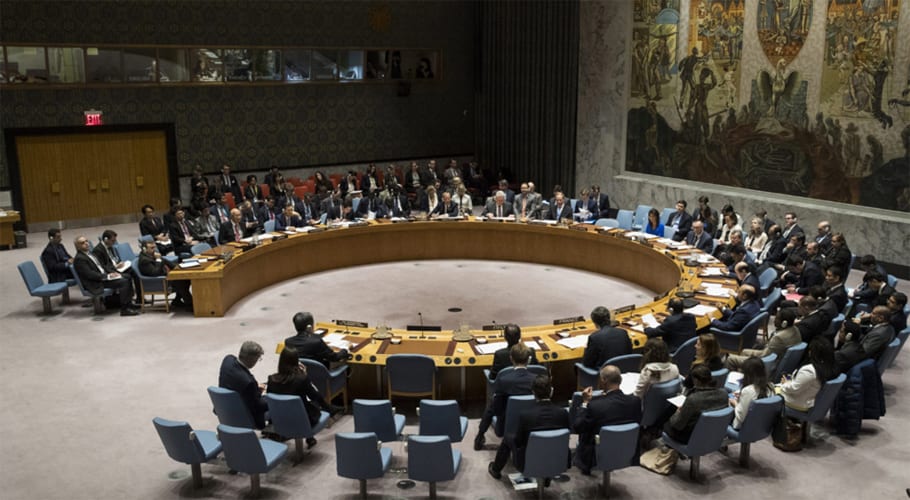
In this regard, the United Nations Security Council has summoned the meeting thrice. Even political leaders have urged the world to consider the alarming situation in IoK but the world remains silent.
The third UNSC meeting recently took place today behind closed doors. This is not the first time the UNSC meeting was held, the first meeting was held just after India’s abrogation of Article 370. The consultative meeting was held after 50 years.
The second UNSC meeting was held in December but it was later canceled after France disagreed to attend the meeting to discuss the dispute of IoK. Any of five permanent members, the United States, Russia, China, Britain, and France can shoot down a UNSC meeting by simply disagreeing with the proposal.
Three meetings were held on the alarming situation of IoK. Although there was development. When will the international community move to give self-determination to oppressed Kashmiris? When will Kashmir be resolved? When will Kashmir see the sun of freedom? The question remains the same.
IoK was once a sovereign state called Jammu and Kashmir, but after the partition in 1947. India and Pakistan subsequently went to war over it and each came to control different parts of the territory with a ceasefire line agreed.
Today, Kashmiris have been bathing in their own blood for more than 5 months. It all began in August 2019, when additional Indian troops were deployed, a major Hindu pilgrimage was canceled, schools and colleges were shut, tourists were ordered to leave, while telephone and internet services were suspended in IoK. Article 35A of the Indian constitution, which gave some special privileges to the people of the state, was then scrapped by the Indian government.
The Indian government under its premier Narendra Modi stunned the world by saying it was revoking nearly all of Article 370, which has been the basis of Kashmir’s complex relationship with India for some 70 years. The article allowed the state a certain autonomy: its own constitution, a separate flag and freedom to make laws. Foreign affairs, defense, and communications remained the preserve of the central government.
Prime Minister Narendra Modi and the Hindu nationalist Bharatiya Janata Party (BJP) had long opposed Article 370 and revoking it was in the party’s 2019 election manifesto. They argued that it needed to be scrapped to integrate Kashmir and place it on the same footing as the rest of India. After returning to power they lost no time in acting on its commitment.
Since its revoke, Pakistan has been urging the United Nations, political leaders of the world to speak up against the violations in Kashmir. The country had approach International Human Rights Commissions like Human Rights Watch (HRW) and Amnesty International with evidence of human rights abuses in IoK. However, the world remains deaf to the cries for help.
For the past 70 years, the massacre in occupied Kashmir has continued, with no serious notice taken to date. Neither has any serious action been taken against India.
India has made many claims of removing the worst humanitarian curfew in IoK but the fact is that there is a ban on the internet, TV, communication, and transport to this day. Oppressed Kashmiris, sadly, still question when they will be freed.
ADVERTISEMENT