Nepal’s Prime Minister K.P. Sharma Oli resigned on Tuesday following an eruption of violent anti-corruption protests, just a day after security forces killed 19 demonstrators. His resignation came as furious protesters defied an indefinite curfew, clashed with police, and set fire to key government buildings, including the national parliament and the headquarters of the ruling Nepali Congress party.
Demonstrators hold flags as smoke rises at the Parliament complex, during a protest against Monday’s killing of 19 people after anti-corruption protests that were triggered by a social media ban, which was later lifted, during a curfew in Kathmandu, Nepal, September 9, 2025. REUTERS/Adnan AbidiDemonstrators react during a protest against Monday’s killing of 19 people after anti-corruption protests that were triggered by a social media ban, which was later lifted, during a curfew in Kathmandu, Nepal, September 9, 2025. REUTERS/Adnan Abidi
An official confirmed that demonstrators stormed and torched the parliament building after Oli stepped down in response to the deadly crackdown. Chaos spread across multiple cities, with so-called Gen-Z protesters continuing to defy curfew orders, leading to street battles with police and widespread arson.
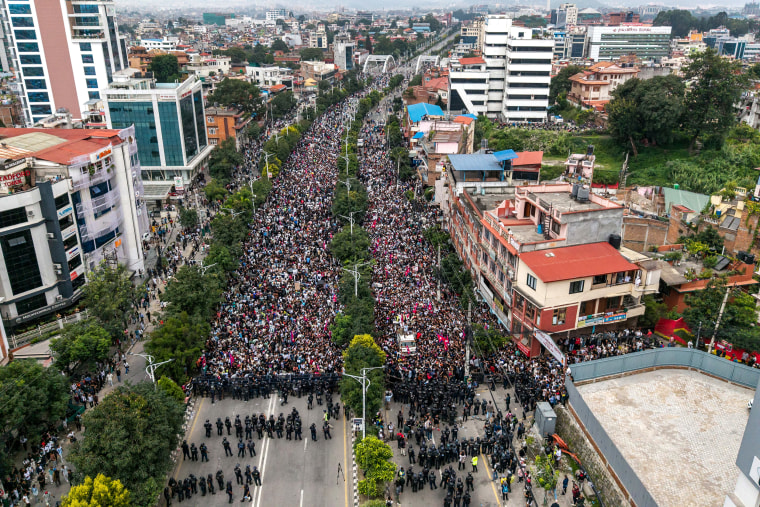
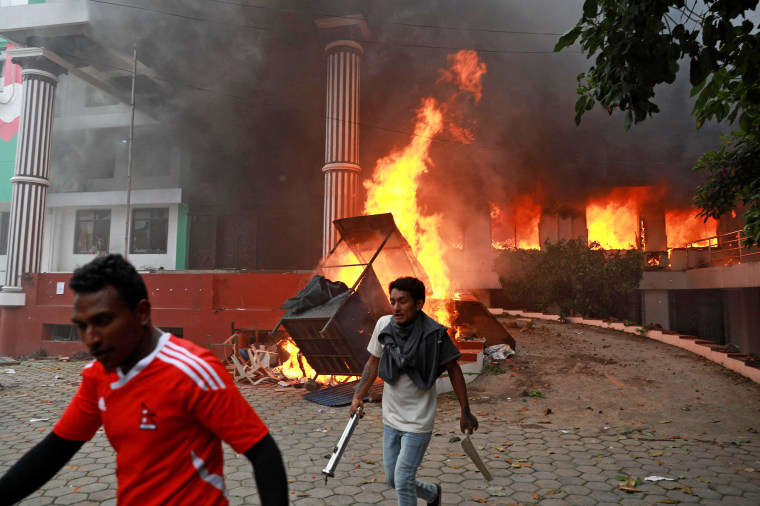
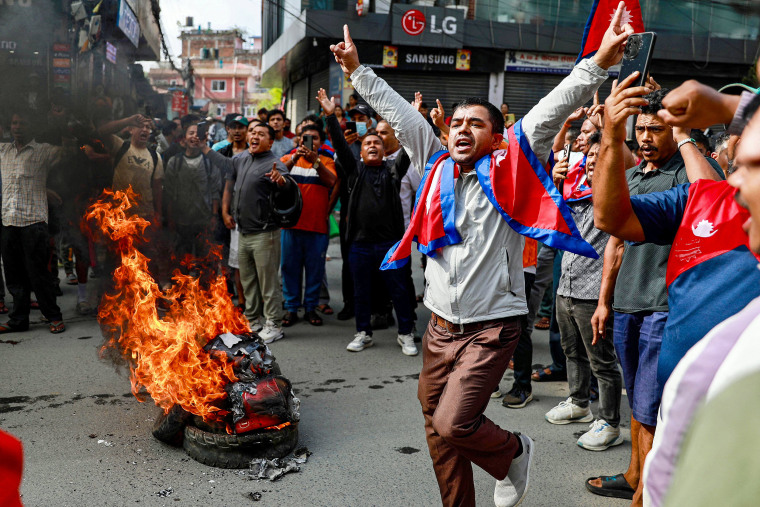
Demonstrators shout slogans as they gather to protest against Monday’s killing of 19 people after anti-corruption protests that were triggered by a social media ban which was later lifted, during a curfew in Kathmandu, Nepal, September 9, 2025. REUTERS/Navesh ChitrakarDemonstrators gather to protest against Monday’s killing of 19 people after anti-corruption protests that were triggered by a social media ban which was later lifted, during a curfew in Kathmandu, Nepal, September 9, 2025. REUTERS/Navesh ChitrakarDemonstrators burn furniture and a police booth outside Nepali Congress party office during a protest against Monday’s killing of 19 people, after anti-corruption protests that were triggered by a social media ban which was later lifted, during a curfew in Kathmandu, Nepal, September 9, 2025. REUTERS/Navesh ChitrakarProtesters gathered outside Nepal’s Parliament in Kathmandu on Monday.Prabin Ranabhat / AFP via Getty Images
The unrest reached the homes of Nepal’s top leaders. Protesters set fire to the residences of several high-profile politicians, including Sher Bahadur Deuba, leader of the Nepali Congress; President Ram Chandra Poudel; Home Minister Ramesh Lekhak; and former Prime Minister Pushpa Kamal Dahal, according to the Associated Press. Local media reported that the army deployed helicopters to evacuate government ministers from their homes.
ADVERTISEMENT
Demonstrators outside the burning Nepali Congress Party office during a protest to condemn the police’s deadly crackdown on demonstrators, in Kathmandu on Tuesday.Prabin Ranabhat / AFP via Getty Images
Home Minister Lekhak resigned late Monday, following an emergency Cabinet meeting.
The protests were initially triggered by a government ban on more than two dozen social media platforms announced last week. However, the demonstrations have since evolved into a broader uprising fueled by public anger over widespread corruption and government dysfunction.
Demonstrators on Tuesday condemn the police’s deadly crackdown on protests in Kathmandu, Nepal.Prabin Ranabhat / AFP – Getty Images
As tensions escalated, authorities closed Tribhuvan International Airport in Kathmandu due to security concerns.
On Monday, the United Nations Human Rights Office called for a “prompt and transparent investigation” into the use of lethal force against protesters.
[Adnan Abidi/Reuters]Demonstrators react outside the Nepali Congress office during a protest to condemn the police’s deadly crackdown on demonstrators in Kathmandu [AFP]Ramyata Limbu, a journalist based in Kathmandu, described a scene of near-total lawlessness in the capital, saying there “seems to be no one in charge,” as young protesters and bystanders vandalized property belonging to senior politicians and political party offices.












![A demonstrator holds a sign as smoke rises at the parliament complex during a curfew in Kathmandu [Adnan Abidi/Reuters]](https://archive.mmnews.tv/wp-content/uploads/2025/09/Nepal-protests.jpg)